
Rechargeable batteries have become essential in modern electronic devices and industrial systems. From electric bicycles, mobility scooters, and medical equipment to industrial automation, robotics, marine electronics, and renewable energy storage, batteries now power applications that demand high reliability, long operating life, and improved energy efficiency.
However, battery performance depends not only on battery quality but also on how the battery is charged. Improper charging can reduce capacity, shorten cycle life, increase heat generation, and even create safety risks.
This is why smart battery chargers have become the preferred choice for both consumers and equipment manufacturers. Unlike conventional chargers that deliver a fixed output regardless of battery condition, smart chargers continuously monitor the battery and automatically adjust charging parameters to maximize performance and safety.
As an experienced manufacturer of battery chargers and power solutions, Guangdong QINX Technology Co.,LTD. develops intelligent charging solutions for OEM and ODM customers worldwide. Our products support a wide range of rechargeable battery technologies, including Lithium-ion, LiFePO4, Lead Acid, AGM, Gel, and other rechargeable battery systems. With customizable charging profiles, multiple connector options, and international safety certifications, Guangdong QINX serves customers across industrial, medical, mobility, energy storage, and consumer electronics markets.
Whether you are selecting a charger for a new product, upgrading an existing system, or sourcing OEM charging solutions, understanding how a smart battery charger works is essential for ensuring long-term battery performance and product reliability.

A smart battery charger, also known as an intelligent battery charger, is an electronic charging device equipped with a microcontroller that automatically controls the charging process based on the battery's condition.
Unlike traditional chargers that simply provide a constant output voltage or current, a smart charger continuously monitors key battery parameters and adjusts its output in real time. This intelligent control helps charge the battery faster, more safely, and more efficiently while minimizing stress on the battery cells.
A typical smart battery charger performs the following functions:
Many advanced chargers also communicate with a Battery Management System (BMS) or use built-in temperature sensors to further improve charging accuracy.
Because of these capabilities, smart chargers are now widely used in applications where battery reliability and lifespan are critical.
Traditional battery chargers were originally designed for older battery technologies and often operate using a fixed charging method. While this approach is simple and inexpensive, it cannot respond to changes in battery condition during charging.
Modern rechargeable batteries—particularly lithium-based chemistries—require much more precise charging control. Small deviations in charging voltage or current can significantly affect battery lifespan and safety.
A smart battery charger addresses these challenges by continuously adapting its charging profile throughout the charging cycle.
Compared with a conventional charger, a smart charger offers several advantages:
For OEM manufacturers, using a smart charger also helps reduce warranty claims and improves the overall reliability of battery-powered products.

The operation of a smart battery charger is based on continuous monitoring and intelligent control.
Instead of supplying maximum power from beginning to end, the charger constantly evaluates the battery's condition and adjusts charging parameters accordingly.
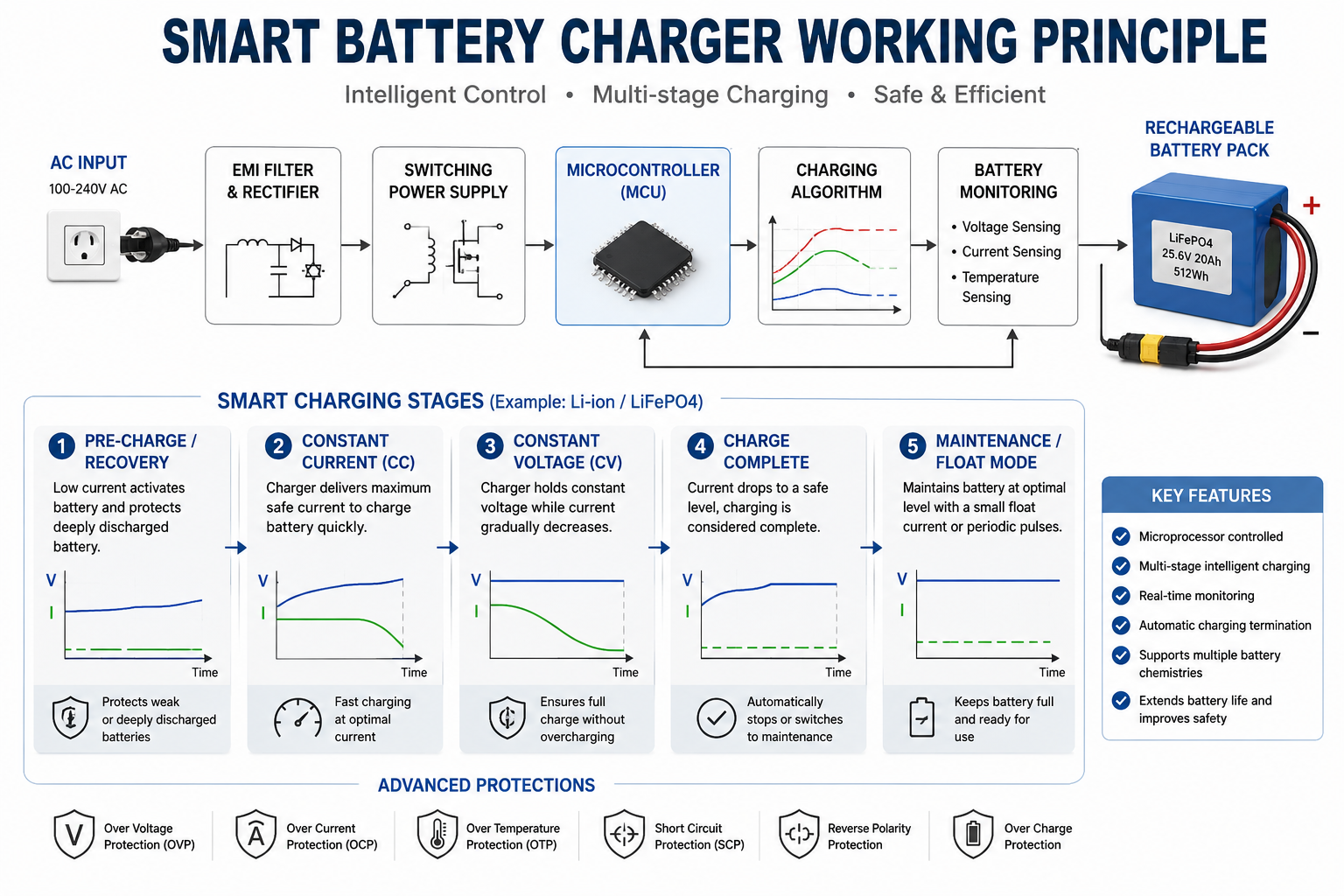
A simplified charging process is shown below:
AC Power Input
        ↓
EMI Filter & Rectifier
        ↓
Switching Power Supply
        ↓
Microcontroller (MCU)
        ↓
Charging Algorithm
        ↓
Battery Monitoring
        ↓
Rechargeable Battery Pack
The microcontroller acts as the brain of the charger. It receives information from voltage sensors, current sensors, and, in some cases, temperature sensors. Based on this data, the charger determines the most appropriate charging stage and adjusts its output automatically.
For example:
This intelligent process ensures that the battery receives exactly the amount of energy it requires at each stage, avoiding unnecessary stress and maximizing battery lifespan.
Suggested Link: Blog → Lithium Battery Charger Guide
Although charger designs vary depending on output power and application, most modern smart chargers share several key components.
The AC input stage receives power from the electrical grid and provides initial filtering to reduce electromagnetic interference (EMI). It also protects the charger against voltage fluctuations and electrical noise.
Instead of using a traditional linear power supply, most smart chargers employ high-frequency switching technology.
This design provides several benefits:
These advantages make switching power supplies the preferred choice for modern battery chargers.
The MCU continuously analyzes battery data and controls the charging process.
Typical MCU responsibilities include:
Without the MCU, a charger cannot perform intelligent charging functions.
Precision sensors continuously monitor charging conditions.
If abnormal values are detected, the charger immediately adjusts its output or activates protective functions.
A smart charger typically integrates multiple safety protections, including:
These features protect both the charger and the connected battery from damage.
The output connector transfers charging power to the battery.
Common connector options include:
Choosing the correct connector is just as important as selecting the correct charging voltage.
A smart battery charger uses a multi-stage charging process controlled by an intelligent microprocessor. Unlike traditional chargers that provide a constant voltage or constant current output, smart chargers continuously monitor battery conditions and automatically adjust charging parameters.
The charging process usually includes several key stages:
When a battery is connected, the smart battery charger first performs an initial check.
The charger detects:
This step prevents incorrect charging and protects both the charger and the battery.
For example, a lithium battery charger designed for a 4-cell LiFePO4 battery pack will recognize whether the connected battery voltage is within the expected range before starting the charging cycle.
Some advanced smart chargers can identify abnormal conditions such as:
If an unsafe condition is detected, the charger will stop output automatically.
During the first major charging stage, the smart charger provides a controlled constant current output.
This stage is designed to quickly restore most of the battery capacity.
For example:
A 14.6V 4.3A LiFePO4 battery charger will provide approximately 4.3A charging current during the constant current stage until the battery voltage approaches the charging limit.
Advantages of constant current charging include:
Compared with basic chargers, smart chargers can optimize charging current according to battery feedback.
When the battery reaches the preset voltage level, the charger switches from constant current mode to constant voltage mode.
During this stage:
This prevents overcharging while allowing the battery to reach a higher state of charge.
For lithium batteries, accurate voltage control is extremely important because excessive voltage may shorten battery lifespan or create safety risks.
After the battery reaches full capacity, the smart charger either stops charging or enters a maintenance mode depending on the battery chemistry and charger design.
For lithium batteries:
For lead-acid batteries:
This intelligent charging management helps extend battery life and prevents unnecessary charging stress.
Many users still use conventional battery chargers because they are simple and inexpensive. However, smart battery chargers provide significant advantages in safety, efficiency, and battery protection.
| Feature | Smart Battery Charger | Traditional Charger |
|---|---|---|
| Charging control | Automatic intelligent control | Fixed charging parameters |
| Battery detection | Yes | Usually no |
| Overcharge protection | Advanced | Limited |
| Charging efficiency | Higher | Lower |
| Battery lifespan | Longer | May reduce lifespan |
| Safety protection | Multiple protections | Basic protection |
| Battery compatibility | Multiple battery types | Limited |
A traditional charger may continue supplying power even when the battery is already full, causing unnecessary stress.
A smart charger automatically adjusts or stops charging according to battery status.
For professional applications such as electric mobility products, industrial equipment, medical devices, and energy storage systems, smart charging technology has become the preferred solution.
A smart battery charger must match the battery chemistry. Different batteries require different charging voltage, current, and charging algorithms.
Lithium-ion batteries are widely used in:
Lithium-ion charging usually follows a CC/CV charging method.
Important requirements include:
For example, a 12.6V charger is commonly used for a 3-cell lithium-ion battery pack, while a 25.2V charger is designed for a 6-cell lithium-ion battery configuration.
Using an incorrect charger voltage can damage lithium batteries.
LiFePO4 (Lithium Iron Phosphate) batteries have become increasingly popular because of their:
However, LiFePO4 batteries require dedicated charging parameters.
Common charging voltages include:
A LiFePO4 smart charger should provide:
Guangdong QINX Technology Co.,LTD. provides customized AC/DC smart battery charger solutions for lithium-ion and LiFePO4 battery applications, supporting different voltage and current requirements for OEM customers.
Lead-acid batteries are still widely used in:
Smart chargers for lead-acid batteries often include:
Compared with old-style lead-acid chargers, smart versions can significantly improve battery performance and reduce maintenance requirements.
When selecting a smart battery charger, buyers should evaluate several important factors.
The charger output voltage must match the battery pack voltage.
Examples:
Using the wrong voltage charger may cause charging failure or battery damage.
Charging current determines charging speed.
A higher charging current provides faster charging but may increase heat generation.
The correct charging current depends on:
For example:
A 100Ah LiFePO4 battery may require a 10A charger for standard charging, while a smaller battery pack may require a lower current charger.
A professional smart battery charger should include multiple protection features:
Prevents excessive charging voltage from damaging the battery.
Limits abnormal charging current caused by faults.
Stops output immediately when a short circuit occurs.
Protects against incorrect battery connection.
Reduces charging output or stops operation when excessive heat is detected.
Charging efficiency directly affects:
Modern smart chargers usually use high-efficiency switching power supply technology to achieve better performance.
For commercial and industrial applications, high efficiency helps reduce operating costs and improves product competitiveness.
Smart battery chargers are widely used across many industries where reliable, safe, and efficient battery charging is required.
From electric mobility products to industrial equipment, the demand for intelligent charging solutions continues to increase as more applications adopt rechargeable battery technology.
Guangdong QINX Technology Co.,LTD. provides AC/DC smart battery charger solutions for OEM manufacturers, distributors, and system integrators worldwide, supporting customized voltage, current, connector, cable, and housing requirements.
Electric mobility is one of the fastest-growing markets for smart battery chargers.
Common applications include:
These products require chargers with:
For example, mobility scooter manufacturers typically require dedicated battery chargers that can safely charge lead-acid or lithium battery packs while ensuring reliable daily operation.
A smart charger helps prevent:
Industrial equipment often operates in demanding environments where charging reliability is critical.
Smart battery chargers are commonly used in:
Industrial customers usually require:
For OEM applications, Guangdong QINX offers customized AC/DC charging solutions according to equipment requirements, including output voltage, charging current, connector types, and protection functions.
Energy storage systems depend on reliable battery charging technology.
Smart chargers are used in:
As lithium batteries become more common in renewable energy applications, smart charging management becomes increasingly important.
A suitable smart charger helps:
Medical devices require extremely reliable power solutions because equipment performance directly affects user safety.
Smart battery chargers can be found in:
Medical applications often require:
Guangdong QINX supports OEM customers requiring customized AC/DC power solutions for different medical and healthcare equipment applications.
Many portable electronic products use rechargeable batteries.
Examples include:
For these products, manufacturers often need chargers with:
A compact smart battery charger allows product designers to create more convenient and user-friendly devices.
Selecting the correct smart battery charger requires understanding both the battery specifications and application requirements.
The wrong charger may result in:
Below are the key factors to consider.
The first step is identifying the battery type.
Common battery chemistries include:
Each battery type requires different charging algorithms.
For example:
A LiFePO4 battery charger cannot simply replace a lithium-ion charger because their charging voltage characteristics are different.
Battery voltage must match the charger's output voltage.
Common examples:
| Battery Type | Battery Configuration | Charger Voltage |
|---|---|---|
| Lithium-ion | 3S | 12.6V |
| LiFePO4 | 4S | 14.6V |
| LiFePO4 | 8S | 29.2V |
| Lithium-ion | 10S | 42V |
| Lithium-ion | 13S | 54.6V |
| LiFePO4 | 16S | 58.4V |
Always confirm the battery manufacturer's charging specification before selecting a charger.
Charging current affects charging speed and battery health.
General considerations:
The ideal charging current depends on:
For OEM projects, charger current can often be customized according to the final product design.
The DC connector is an important part of charger compatibility.
Common connector options include:
Different industries may require different cable lengths, wire gauges, and connector designs.
Guangdong QINX supports customized DC cable solutions for OEM customers, helping integrate chargers into complete product systems.
For commercial products, certification requirements are important.
Common charger certifications include:
Certified chargers help manufacturers meet regional compliance requirements and improve product acceptance.
Different products have different charging requirements.
A standard off-the-shelf charger may not always meet every application's needs.
OEM customization allows manufacturers to optimize:
Guangdong QINX Technology Co.,LTD. specializes in customized AC/DC Battery Charger and power adapter solutions for global OEM customers.
With manufacturing experience in power supplies and chargers, Guangdong QINX supports projects from prototype development to mass production.
Customers provide:
Our engineering team evaluates:
Samples are produced for:
After approval, products enter production with quality control procedures to ensure consistent performance.
Choosing the right charger manufacturer is critical for product reliability and long-term cooperation.
Guangdong QINX Technology Co.,LTD. focuses on providing professional AC/DC power solutions including:
Key advantages include:
Supporting power solutions from 1W to 420W for different applications.
Supporting customized:
Products can be developed according to international safety and efficiency requirements.
Working directly with Guangdong QINX provides customers with:
For OEM manufacturers, distributors, and professional buyers, selecting the right smart battery charger is more than choosing a product with the correct voltage and current.
A reliable charger supplier should provide:
Before purchasing smart battery chargers in bulk, consider the following factors.
The most important information includes:
Confirm whether the battery is:
Different batteries require different charging algorithms.
Examples:
The charger voltage must match the battery configuration.
Battery capacity is measured in Ah (Ampere-hours).
Charging current selection depends on battery capacity.
For example:
A small battery pack may require a 2A–3A charger, while a larger energy storage battery may require a 10A or higher charging current.
A smart battery charger operates as a critical part of the complete product system.
Poor-quality chargers may cause:
Important quality factors include:
High-quality components improve:
Effective heat management helps maintain reliable operation during continuous charging.
Professional chargers should include:
For OEM projects, supplier stability is essential.
A qualified smart battery charger manufacturer should have:
Guangdong QINX Technology Co.,LTD. works with global customers requiring customized AC/DC power adapters and battery charging solutions for different industries.
Even with intelligent charging technology, users may occasionally experience charging problems.
Below are common issues and possible solutions.
Possible causes:
Solutions:
Possible causes:
Solutions:
Possible causes:
Solutions:
A certain amount of heat generation is normal during charging.
However, excessive temperature may indicate:
A properly designed smart battery charger should maintain safe operating temperatures through efficient circuit design and thermal management.
A smart battery charger is an intelligent charging device that automatically monitors battery status and adjusts charging parameters to provide safe and efficient charging.
Unlike traditional chargers, smart chargers can detect battery conditions and use multi-stage charging technology.
The main difference is charging control.
A normal charger usually provides fixed charging output, while a smart charger automatically manages:
Smart chargers generally provide better battery protection and longer battery life.
Not every smart charger can charge all battery types.
Lithium-ion, LiFePO4, and lead-acid batteries require different charging methods.
A charger must be specifically designed or configured for the intended battery chemistry.
Charging time depends on:
A simple calculation:
Charging Time ≈ Battery Capacity (Ah) ÷ Charging Current (A)
For example:
A 50Ah battery charged with a 5A charger may theoretically require about 10 hours.
Actual charging time may be longer because charging current decreases during the final charging stage.
A properly designed smart battery charger should prevent overcharging through intelligent charging control and protection functions.
However, selecting the correct charger voltage and battery type is essential.
Certification requirements depend on the target market.
Common certifications include:
Certified chargers help manufacturers comply with regional regulations.
Yes.
Guangdong QINX Technology Co.,LTD. provides OEM and customized AC/DC charger solutions based on customer requirements.
Customization options include:
Smart battery chargers have become an essential component in modern rechargeable battery applications.
Compared with traditional chargers, smart chargers provide:
For OEM manufacturers and distributors, choosing an experienced charger supplier is critical.
Guangdong QINX Technology Co.,LTD. specializes in AC/DC power adapters, battery chargers, and customized power solutions, supporting global customers with reliable products and flexible OEM services.
Whether you need a lithium battery charger, LiFePO4 battery charger, or customized smart charging solution, Guangdong QINX can provide professional technical support and manufacturing capability.
Contact Guangdong QINX today to discuss your smart battery charger requirements.


