
When selecting a power adapter or battery charger, buyers usually focus on output voltage, current, and power. However, the DC connector type is equally important for ensuring electrical and mechanical compatibility.
A power adapter can have the correct voltage and current but still fail to power a device if the connector size, polarity, pin configuration, or locking mechanism is incorrect. A mismatched connector may cause loose connections, intermittent power loss, poor electrical contact, voltage drop, or excessive heating.
For example, 5.5 × 2.1 mm and 5.5 × 2.5 mm DC barrel connectors look very similar but are not automatically interchangeable. Understanding connector dimensions and specifications before ordering a power adapter or battery charger can help prevent compatibility problems and unnecessary sample revisions.
As a professional manufacturer of power adapters and battery chargers, Guangdong QINX Technology Co., Ltd. supports a wide range of DC connector configurations for OEM and ODM power supply projects.
This guide explains the most common DC connector types and DC plug types, including connector sizes, applications, advantages, limitations, polarity, and the key factors to consider when selecting a connector.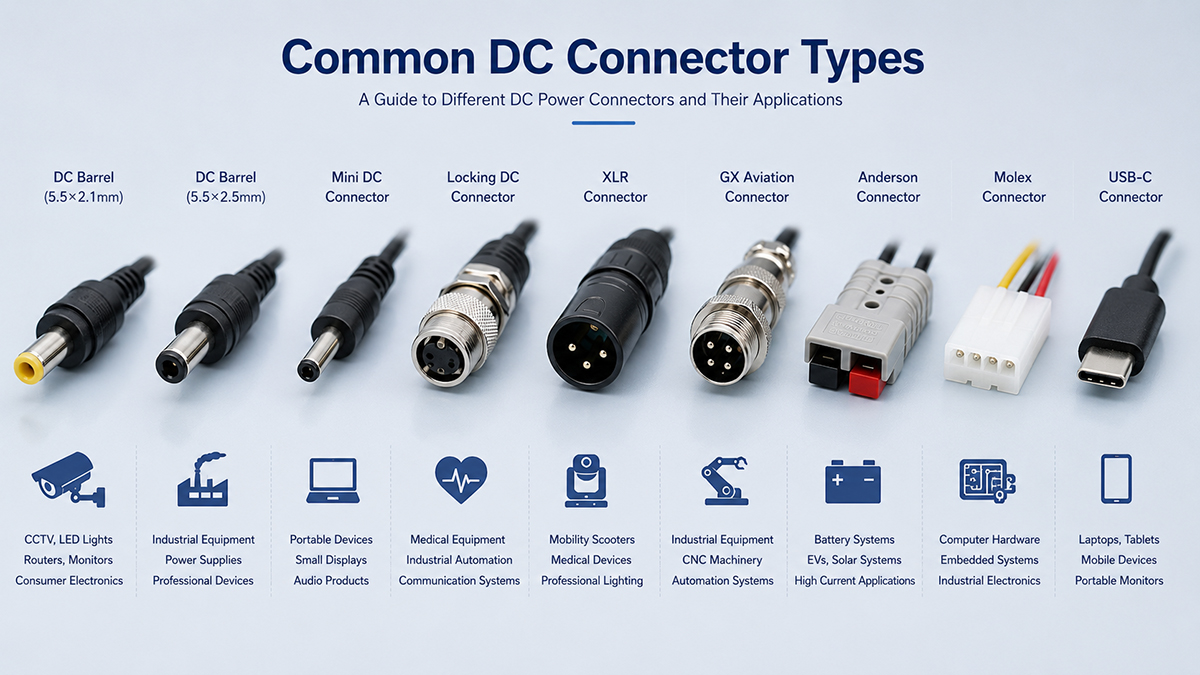
A DC connector is an electrical interface used to transfer direct current (DC) power between a power source and an electronic device.
DC connectors are commonly used with:
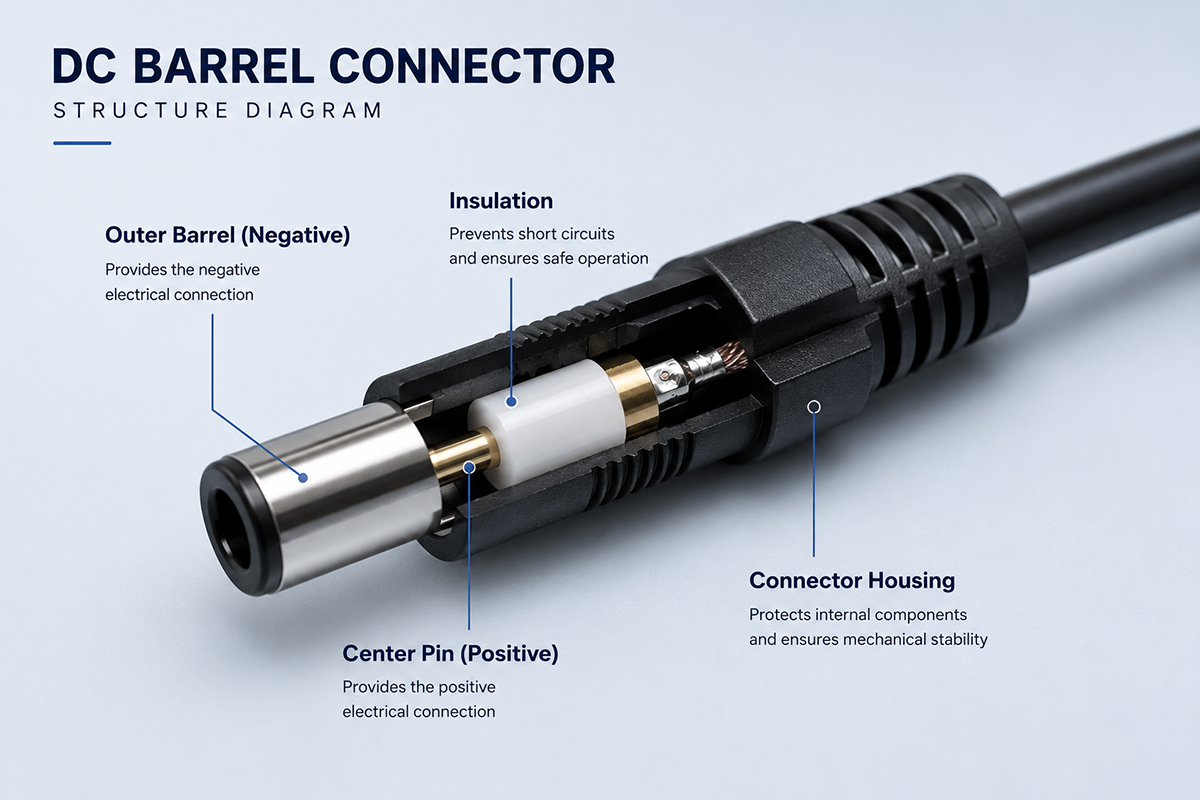
A typical DC connector may include:
The connector should provide stable electrical contact, low contact resistance, mechanical reliability, and safe operation.
The appropriate connector depends on several factors, including voltage, current, connector dimensions, polarity, cable size, installation environment, and mechanical requirements.
Related Reading: What Is A Power Adapter?
DC connectors are not universally interchangeable.
Two connectors may look almost identical but have different inner diameters, outer diameters, pin configurations, polarity, current ratings, or locking mechanisms.
Using an unsuitable connector may result in:
For power adapter and battery charger projects, connector specifications should be confirmed before samples or mass production are started.
A complete connector specification should ideally include the connector type, dimensions, polarity, pin configuration, cable length, cable size, and mechanical requirements.
Different applications require different DC connector designs. The following are some of the most common DC power connector types used in power adapters, battery chargers, electronic equipment, and industrial systems.
DC barrel connectors are among the most common connectors used with power adapters and low-voltage DC power supplies.
They are widely used in:
A DC barrel connector is typically identified by its dimensions:
Outer Diameter × Inner Diameter
Common examples include:
The connector dimensions should always be confirmed before selecting a replacement power adapter.
See Common DC Connector Types
Explore examples of DC plugs and connectors commonly used with power adapters, battery chargers, and electronic equipment.
The 5.5 × 2.1 mm DC connector is one of the most widely used DC barrel connector sizes.
It has an approximately 5.5 mm outer diameter and a 2.1 mm inner diameter.
The connector size alone does not determine its maximum current. The actual connector rating, contact design, cable size, and operating conditions must also be considered.
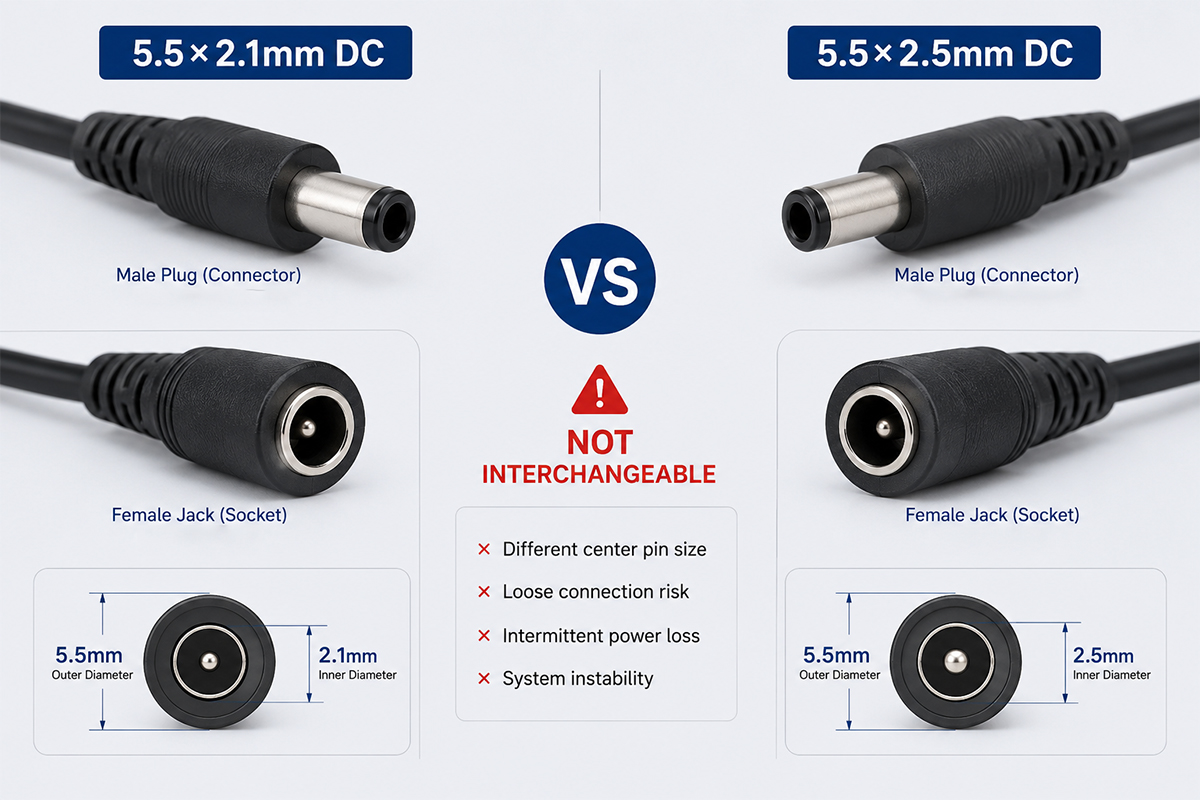
The 5.5 × 2.5 mm DC connector has the same nominal outer diameter as a 5.5 × 2.1 mm connector but a larger inner diameter.
Because the external dimensions are similar, these two connector sizes are frequently confused.
A 5.5 × 2.1 mm plug may physically fit into some 5.5 × 2.5 mm jacks, but this does not mean that the connection is electrically reliable.
The difference in inner diameter can result in:
Therefore, 5.5 × 2.1 mm and 5.5 × 2.5 mm connectors should not be assumed to be interchangeable.
12V DC connector types are widely used in LED systems, CCTV equipment, routers, networking devices, control systems, consumer electronics, and other low-voltage applications.
Common connector options for 12V DC power include:
However, the 12V output voltage alone does not determine which connector should be used.
Connector selection should also consider:
For example, two devices may both require 12V DC but use completely different connector types.
24V DC connector types are commonly used in industrial equipment, automation systems, LED lighting, control systems, networking equipment, and other DC-powered applications.
Common options include:
For a 24V power supply, connector selection should consider the required current as well as the voltage.
Higher-current applications may require connectors with higher current ratings, larger contacts, better cable support, or a locking mechanism.
Therefore, 24V DC connector selection should be based on the complete electrical and mechanical requirements rather than voltage alone.
Mini DC connectors are designed for applications where installation space is limited.
They are commonly used in:
The exact specifications vary by connector series, so the connector should be selected according to the manufacturer’s electrical and mechanical ratings.
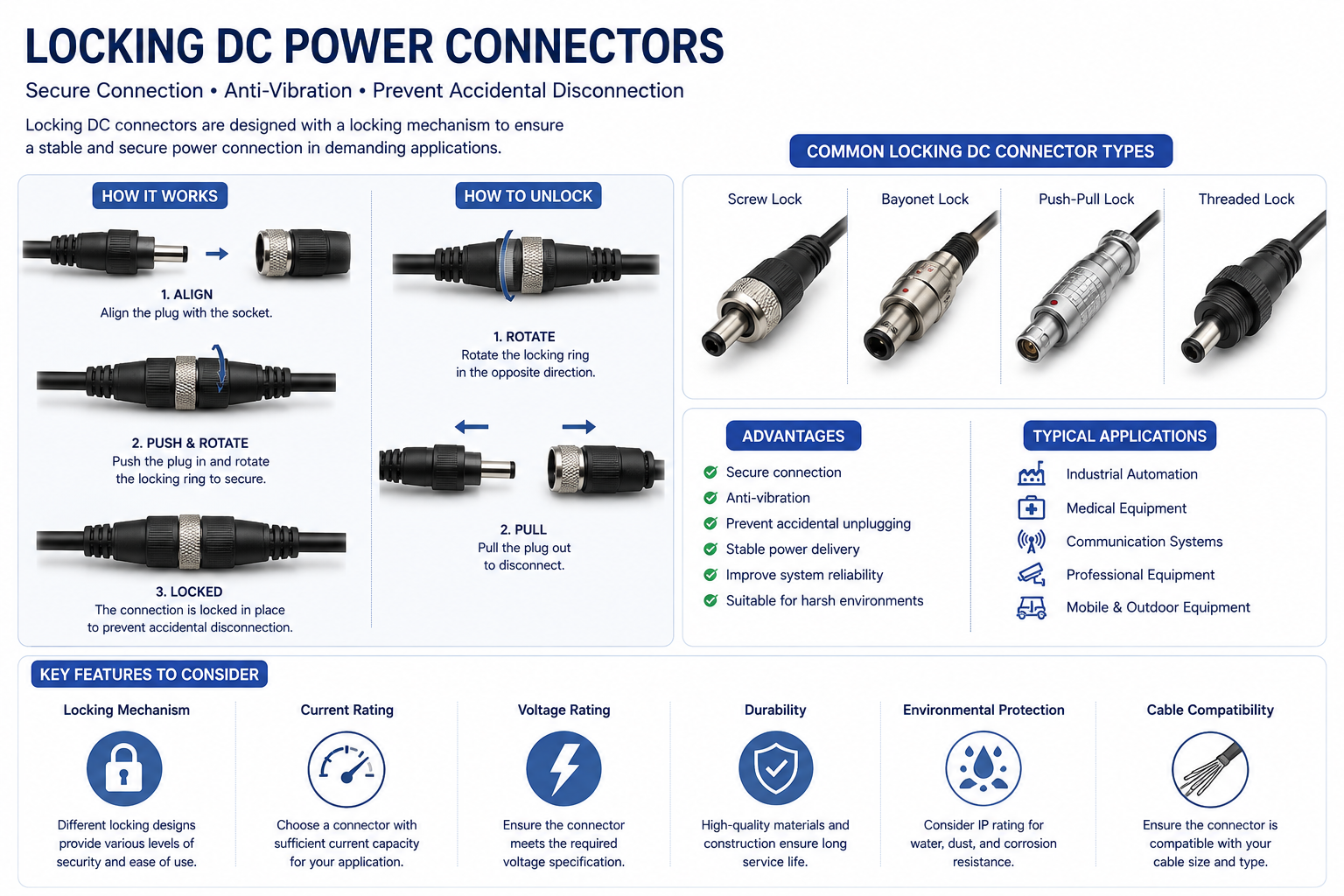
Locking DC connectors are designed to reduce accidental disconnection.
They are useful when equipment is exposed to vibration, movement, or frequent cable handling.
XLR connectors are widely recognized in professional audio applications, but certain XLR configurations are also used for DC power transmission.
DC power applications may use different XLR pin configurations depending on the equipment design.
Common configurations include:
When specifying an XLR connector for DC power, always confirm the pin configuration and polarity rather than relying only on the connector’s appearance.
GX connectors are commonly used in industrial and electronic equipment where a secure connection is required.
Common models include:
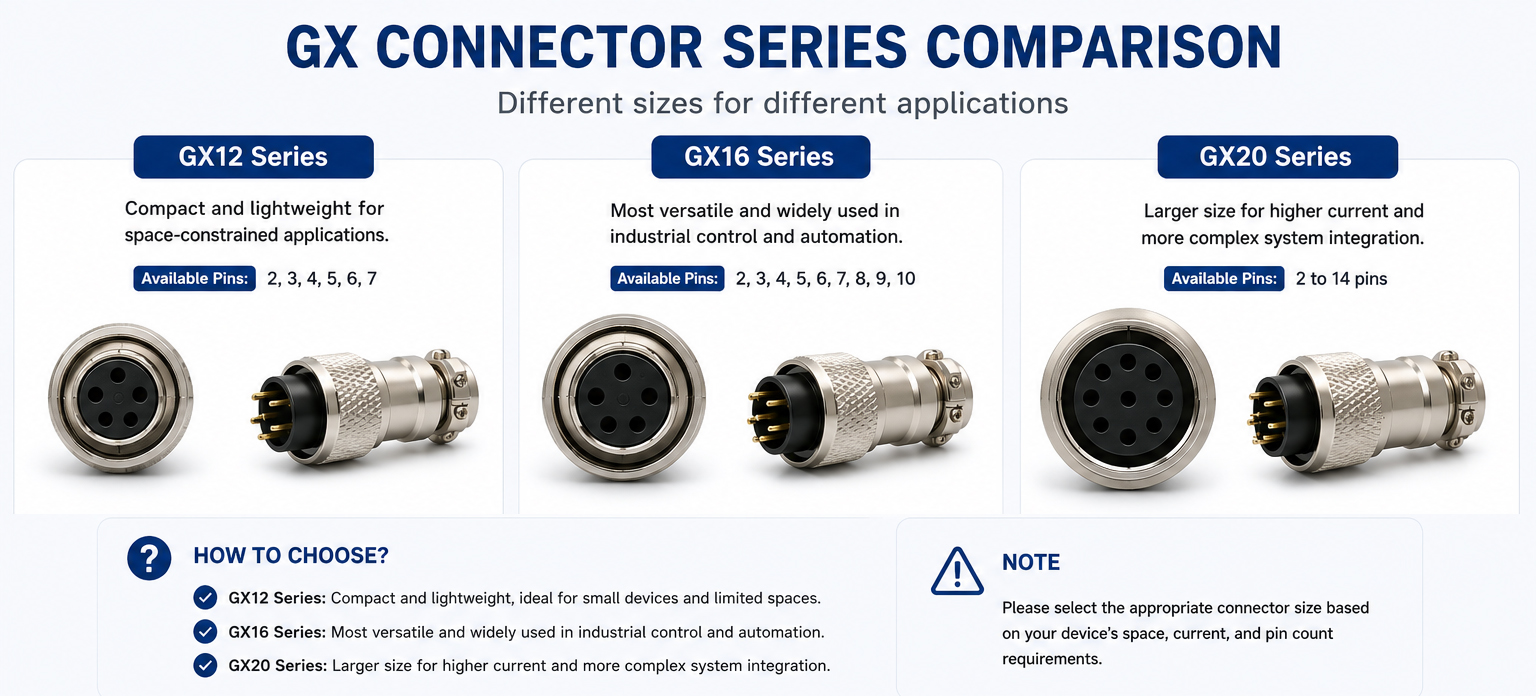
Anderson-style connectors are commonly used for higher-current DC power applications.
They can be found in:
Some connector families are designed for applications ranging from tens of amps to much higher current levels.
The appropriate connector must always be selected according to its rated current, cable size, duty cycle, and operating environment.
Molex is a broad family of connector systems used in electronic equipment.
Depending on the specific connector series, Molex connectors may be used for:
Molex connectors should be specified by the exact product series, pitch, contact configuration, and electrical ratings rather than simply by the brand name.
USB-C has become increasingly important for power delivery in consumer and portable electronics.
Typical applications include:
Higher-power USB-C applications may require compatible USB Power Delivery hardware and communication between the power source and device.
A USB-C connector alone does not automatically mean that a power supply can deliver every USB-C power level.
The terms DC connector, DC plug, and DC jack are often used interchangeably, but they can refer to different parts of a connection system.
“DC connector” is the broad term for an electrical connector used for DC power.
A DC plug generally refers to the cable-mounted mating component that connects to the equipment.
For example, a DC barrel plug may be attached to the output cable of a power adapter.
A DC jack generally refers to the receptacle mounted on the equipment.
For example, a router, monitor, or electronic device may have a DC jack designed to accept a DC barrel plug.
Understanding these terms helps avoid confusion when specifying DC plug types or replacement power adapters.
Connector size is one of the most important factors when selecting a DC power connector.
A connector should not be selected based only on its appearance.
For DC barrel connectors, dimensions are commonly expressed as:
Outer Diameter × Inner Diameter
For example:
5.5 × 2.1 mm
and
5.5 × 2.5 mm
have the same nominal outer diameter but different inner diameters.
This difference can affect mating compatibility and electrical contact.
Barrel connector length can also vary.
A plug with the correct outer and inner diameter may still be unsuitable if the plug length does not match the equipment’s jack design.
Polarity must always be confirmed before connecting a DC power supply.
A common configuration is center-positive, but polarity should never be assumed.
The connector specification should clearly identify:
The connector must be rated for the expected operating current.
A connector that is too small for the application may have excessive contact resistance and generate unwanted heat.
The actual current capability depends on the connector design, contact materials, cable size, temperature, and operating conditions.
The connector must be compatible with the cable conductor size and expected current.
When customizing a power adapter or battery charger, cable length and wire gauge should be specified together with the connector.
|
Connector Type |
Typical Applications |
Main Advantage |
Key Consideration |
|---|---|---|---|
|
5.5 × 2.1 mm Barrel |
LED, CCTV, routers |
Widely available |
Confirm size and polarity |
|
5.5 × 2.5 mm Barrel |
Electronics, industrial equipment |
Common power connector |
Not automatically interchangeable with 2.1 mm |
|
Mini DC |
Compact electronics |
Small size |
Current capability |
|
Locking DC |
Industrial equipment |
Secure connection |
Space and cost |
|
XLR |
Professional equipment |
Durable connection |
Pin configuration |
|
GX12/GX16/GX20 |
Industrial equipment |
Secure and robust |
Connector size |
|
Anderson |
Battery and high-current systems |
High current capability |
Rated current and cable size |
|
Molex |
Internal electronics |
Compact configurations |
Exact series and pin configuration |
|
USB-C |
Portable electronics |
Reversible and PD capable |
PD compatibility |
Choosing the correct DC connector requires more than matching the connector’s appearance.
Before ordering samples or production units, verify the following specifications.
Confirm that the power adapter or battery charger provides the required output voltage.
For example, a device designed for 12V DC should use a power supply with the correct output voltage specified by the equipment manufacturer.
For more information about voltage selection, see: Power Adapter Voltage Explained
The connector should be rated for the expected operating current.
A connector that is too small for the application may experience excessive contact resistance and heating.
For more information: Power Adapter Current Explained
For barrel connectors, confirm both:
For example:
5.5 × 2.1 mm is different from 5.5 × 2.5 mm.
Never select a replacement connector based only on visual similarity.
Check the connector polarity before connecting a power supply.
A common configuration is center-positive, but polarity should always be confirmed from the equipment specification, connector drawing, or original power supply.
Check the cable gauge and cable length according to the required current, voltage drop, installation space, and application.
For applications involving vibration, movement, or frequent handling, a locking connector may provide better mechanical reliability.
Consider:
If the connector will be frequently connected and disconnected, choose a connector designed for the required number of mating cycles.
Some applications may have specific connector, cable, or power supply requirements.
For related information: Power Adapter Safety Certifications Explained
Two connectors can look almost identical while having different internal dimensions or electrical specifications.
The connector must be capable of safely handling the expected operating current.
Straight and right-angle connectors may have significantly different installation requirements.
Incorrect polarity can prevent operation and, depending on the equipment design, may cause damage.
5.5 × 2.1 mm and 5.5 × 2.5 mm connectors are a common example of similar-looking but different connector dimensions.
When requesting a custom power adapter, specifying only voltage and current is often insufficient.
The connector specification should ideally include:
For OEM and ODM power supply projects, incomplete connector information can lead to unnecessary sample revisions.
For example, a customer may provide:
but not specify:
Providing a connector drawing, photograph, sample, or accurate dimensions can significantly improve communication between the equipment manufacturer and power supply manufacturer.
Before requesting samples, customers should ideally confirm the connector specifications together with the required voltage, current, cable length, and other mechanical requirements.
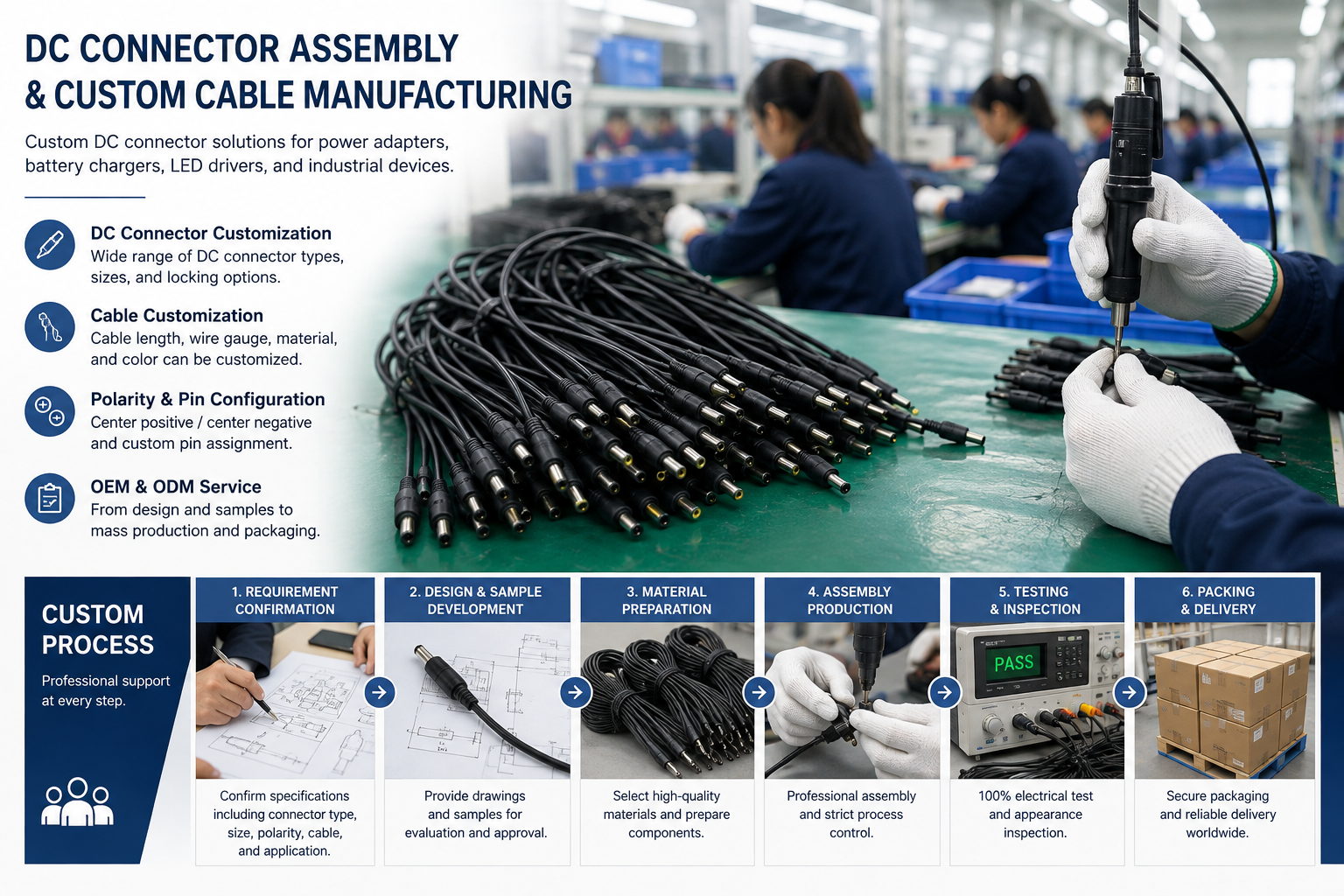
Connector selection is only one part of power supply development.
An experienced power supply manufacturer can assist with:
Guangdong QINX Technology Co., Ltd. provides customized power adapters, battery chargers, LED drivers, and switching power supplies from 1W to 420W, with support for a wide range of DC connector options.
For customized projects, connector specifications can be coordinated together with output voltage, output current, cable length, housing, label, packaging, and other requirements.
Related Reading:
How To Choose The Right Power Adapter?
Common DC connector types include DC barrel connectors, mini DC connectors, locking connectors, XLR connectors, GX connectors, Anderson connectors, Molex connectors, and USB-C connectors.
The appropriate type depends on the voltage, current, connector dimensions, polarity, mechanical requirements, and application.
Common 12V DC connector options include 5.5 × 2.1 mm and 5.5 × 2.5 mm barrel connectors, mini DC connectors, locking connectors, XLR connectors, GX connectors, and custom connectors.
The correct choice depends on the required current, connector dimensions, polarity, cable size, and application.
Common 24V DC connector options include barrel connectors, locking DC connectors, GX connectors, XLR connectors, and custom connectors.
The connector should be selected according to the required current, dimensions, polarity, and mechanical requirements.
Both connectors have a nominal 5.5 mm outer diameter, but their inner diameters are different.
A 5.5 × 2.1 mm plug should not be assumed to be compatible with a 5.5 × 2.5 mm jack.
They can be, but voltage alone does not determine connector type.
The same connector family may be used for different DC voltages if its electrical and mechanical ratings are suitable for the application.
Measure the connector’s outer diameter and inner diameter.
For example, a 5.5 × 2.1 mm connector has an approximately 5.5 mm outer diameter and 2.1 mm inner diameter.
Connector length and polarity should also be confirmed.
A DC plug generally refers to the cable-mounted mating connector, while a DC jack generally refers to the receptacle mounted on the equipment.
Check the required voltage, current, connector dimensions, polarity, cable size, connector length, mechanical requirements, environmental conditions, and locking requirements before selecting the connector.
Not necessarily.
Even when the voltage and current ratings are correct, the connector may be mechanically incompatible or have the wrong polarity or pin configuration.
The connector should be confirmed separately from the electrical specifications.
Choosing the correct DC connector is just as important as selecting the correct voltage and current for a power adapter or battery charger.
Understanding DC connector types, DC plug types, connector sizes, polarity, current ratings, cable requirements, and application conditions can help prevent compatibility problems and unnecessary sample revisions.
Whether your project requires a 5.5 × 2.1 mm barrel connector, 5.5 × 2.5 mm connector, locking DC connector, XLR connector, GX aviation connector, Anderson connector, Molex connector, USB-C connector, or a custom solution, the connector should be selected according to the complete electrical and mechanical requirements of the application.
For OEM and ODM power supply projects, working with an AC/DC Power Supply Manufacturer can also simplify connector selection, cable customization, and product development.
Guangdong QINX Technology Co., Ltd. specializes in AC/DC power adapters, battery chargers, LED drivers, and switching power supplies ranging from 1W to 420W.
The company provides OEM and ODM power supply solutions for industrial equipment, LED systems, networking equipment, automation systems, consumer electronics, and other DC-powered applications worldwide.
For customized power supply projects, Guangdong QINX supports connector customization, cable length, connector configuration, labels, packaging, and other OEM/ODM requirements.


