

Voltage is measured in volts (V) and describes the electrical potential difference between two points.
For a conventional AC/DC power adapter, the output voltage is one of the most important specifications because it determines the nominal DC voltage delivered to the equipment.
For example, a power adapter may be specified as:
Input: 100–240V AC, 50/60Hz
Output: 12V DC, 5A
Power: 60W
The adapter accepts AC power from the electrical outlet and converts it into regulated DC power for the connected device.
The 12V specification is the adapter's nominal output voltage.
If the equipment requires 12V DC, a 12V adapter is normally the appropriate starting point for compatibility evaluation.
By contrast, replacing a 12V adapter with a 24V adapter simply because both adapters may have sufficient wattage is not normally acceptable.
This is why understanding output voltage is essential when purchasing, replacing, or designing a power adapter.
A common misunderstanding is confusing the adapter's input voltage with its output voltage.
These two specifications describe completely different parts of the power conversion process.
The input voltage is the electricity supplied to the adapter.
A typical global power adapter may specify:
100–240V AC, 50/60Hz
This means the adapter is designed to accept a broad range of AC mains voltages.
The output voltage is the electrical voltage supplied by the adapter to the electronic device.
For example:
Output: 19V DC
The adapter converts the incoming AC voltage into a regulated 19V DC output.
Therefore:
Input voltage = electricity supplied to the adapter
Output voltage = electricity supplied from the adapter to the equipment

Electronic equipment is designed around specific electrical requirements.
Internal components such as integrated circuits, sensors, motors, LEDs, processors, communication modules, and control circuits may only operate correctly within certain voltage limits.
If the supplied voltage is too high, components can experience excessive electrical stress.
If the supplied voltage is too low, the equipment may fail to start or may operate unstably.
Potential problems caused by incorrect voltage include:
Device failure to start
Unexpected shutdown
Repeated restarting
Excessive heat
Reduced component lifespan
Circuit damage
Motor performance problems
LED brightness problems
Communication instability
Permanent equipment damage
For this reason, the correct power adapter voltage should be verified before connecting the adapter to the equipment.
Suppose a device requires:
12V DC
but the selected adapter provides:
24V DC
The adapter is supplying significantly more voltage than the equipment expects.
Depending on the device's internal protection and circuit design, this may result in:
Overvoltage protection activating
Excessive current through sensitive components
Component overheating
Electronic circuit failure
Permanent damage
Some devices support a defined input-voltage range, such as 9–15V DC. If the manufacturer explicitly specifies this range, different voltages within the stated range may be acceptable.
However, this should never be assumed simply because the difference appears small.
When a device specifies 12V DC, the safest general approach is to select a properly regulated 12V DC adapter unless the manufacturer's documentation states otherwise.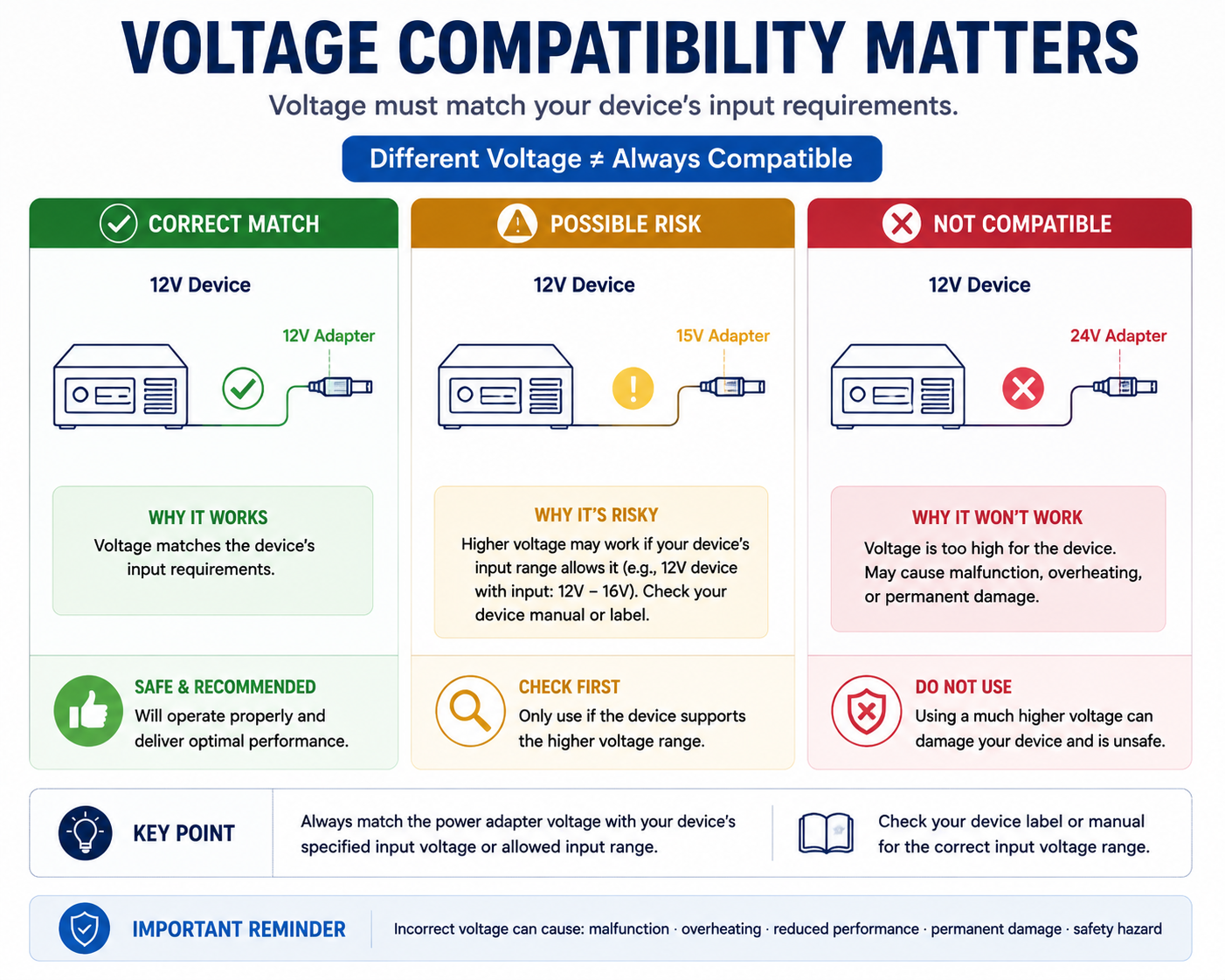
A lower voltage can also cause problems.
For example, if equipment requires:
24V DC
but receives:
12V DC
the equipment may not receive sufficient voltage for normal operation.
Possible symptoms include:
Failure to start
Unstable operation
Repeated resets
Motor performance problems
Reduced LED output
Communication interruptions
Error messages
Increased input current in some circuit designs
The equipment may sometimes appear to work under light loads but fail when its power demand increases.
Therefore, "lower voltage is safer" is not a reliable assumption.
Power adapters are available in a wide range of DC output voltages.
Depending on the application, commonly used and specialized output-voltage options can include:
5V, 9V, 12V, 13.5V, 14V, 15V, 16V, 17V, 18V, 19V, 19.5V, 20V, 24V, 25V, 26V, 27V, 28V, 29V, 30V, 32V, 36V, 42V, 48V, and 54V.
These voltage levels can be grouped into several practical ranges.
| Voltage Group | Available Voltage Examples |
|---|---|
| Low-voltage DC | 5V, 9V |
| Common low/mid-voltage DC | 12V, 13.5V, 14V, 15V |
| Mid-voltage DC | 16V, 17V, 18V, 19V, 19.5V, 20V |
| Higher-voltage DC | 24V, 25V, 26V, 27V, 28V, 29V, 30V, 32V |
| High-voltage DC applications | 36V, 42V, 48V, 54V |
The exact voltage required depends on the design of the equipment.
Guangdong QINX supports a broad range of AC/DC power adapter voltage requirements, including standard and application-specific output voltages.
Customers can explore AC/DC power adapters by output voltage when looking for a suitable voltage platform.
5V is one of the most widely used low-voltage DC platforms.
5V power adapters may be used for:
Small electronic equipment
Embedded systems
Sensors
Controllers
IoT devices
Consumer electronics
USB-related electronics
Because low-voltage electronics can be sensitive to power quality, a regulated and appropriately rated power adapter is important.
For any 5V application, the required current, connector, polarity, and power rating should also be verified.
9V power adapters are commonly associated with certain audio equipment, electronic devices, networking products, and specialized applications.
Although 9V is a standard nominal voltage, the connector and polarity can vary between devices.
Therefore, a 9V adapter should not be considered compatible simply because the voltage matches.
12V is one of the most common DC output voltages in electronic equipment.
Typical applications can include:
CCTV security equipment
Networking devices
LED lighting
Audio equipment
Industrial electronics
Control systems
Consumer electronics
A 12V adapter may be available with different current ratings.
For example:
12V × 2A = 24W
12V × 5A = 60W
12V × 10A = 120W
The output voltage remains 12V while the available current and power increase.
You can explore 12V power adapters for the 12V voltage category.
Not all equipment uses round-number voltage platforms such as 12V or 15V.
Some applications require intermediate voltage levels such as 13.5V or 14V.
These requirements can arise from the electrical architecture of specialized equipment, battery-related systems, communications equipment, and other electronic applications.
A 13.5V or 14V adapter should therefore be selected based on the equipment manufacturer's specified input voltage rather than automatically replacing it with a nearby 12V or 15V adapter.
The difference may appear small, but the equipment's input-voltage tolerance determines whether substitution is acceptable.
15V, 16V, 17V, and 18V power adapters can be used in various electronic and professional applications.
These voltage levels may appear in:
Audio equipment
Monitors
Industrial electronics
Communication equipment
Specialized consumer electronics
Control systems
When selecting one of these voltage levels, always verify the equipment's exact specification.
For example, a device requiring 16V should not automatically be connected to a 19V adapter simply because both adapters have similar wattage.
19V is a widely recognized power-adapter voltage, particularly for certain monitors, displays, computing equipment, and electronics.
19.5V is also used by certain equipment manufacturers.
20V is another important DC output platform and can appear in professional and consumer electronics.
These voltage levels demonstrate why exact specification checking is important.
For example:
19V ≠ 19.5V ≠ 20V
Whether one voltage can replace another depends on the equipment's designed input range.
For a device specifying 19.5V DC, a 19.5V power adapter is the most straightforward choice unless the manufacturer provides a permitted range.
24V is widely used in industrial, commercial, LED, control, and professional electronic equipment.
Typical applications can include:
Industrial control equipment
Automation systems
LED systems
Security equipment
Communication equipment
Sensors
Robotics
Displays
24V systems can require higher power levels than small consumer electronics.
For example:
24V × 5A = 120W
This makes 24V an important platform for medium-power applications.
Guangdong QINX provides 24V AC/DC power adapter solutions for different current and power requirements.
25V, 26V, 27V, and 28V are more specialized output-voltage requirements.
These voltage levels can be relevant when an electronic system has been designed around a particular DC input voltage rather than a commonly standardized platform.
For OEM equipment manufacturers, using the exact required voltage can simplify system design and avoid unnecessary additional voltage-conversion stages.
When a customer specifies 26V, for example, the appropriate solution should normally be evaluated as a 26V DC power supply, rather than assuming that a 24V or 28V model will work.
29V, 30V, and 32V represent another group of specialized DC output voltages.
These may be used in equipment where the internal electronic architecture requires a higher DC input voltage.
For these applications, voltage accuracy and regulation can become particularly important.
A 30V device should not automatically be powered with a 32V adapter unless its specified input range explicitly allows 32V.
36V power adapters are used in higher-voltage electronic and specialized equipment.
They can be relevant to:
Industrial equipment
Battery-related systems
Motor-driven equipment
Professional electronics
Specialized control systems
As voltage increases, power can be delivered at lower current compared with an equivalent-power lower-voltage system.
For example:
36V × 3A = 108W
This illustrates why voltage, current, and power must always be evaluated together.
42V is an important voltage level in certain specialized equipment and battery-related applications.
When selecting a 42V adapter, the exact application requirements should be verified carefully.
A 42V power adapter is not interchangeable with a 36V or 48V adapter simply because all three are considered higher-voltage DC solutions.
The equipment manufacturer's input specification should determine the appropriate voltage.
48V is widely used in professional electronics, networking, telecommunications, industrial equipment, and other higher-voltage applications.
For example:
48V × 2.5A = 120W
Compared with 12V at the same power:
12V × 10A = 120W
The 48V system requires significantly less current for the same output power.
However, higher-voltage applications require appropriate attention to insulation, connector ratings, cable selection, protection, and applicable safety requirements.
54V represents one of the higher output-voltage platforms in the QINX AC/DC adapter range.
This type of voltage can be relevant to specialized networking, telecommunications, industrial, and other professional electronic applications.
At higher output voltages, system designers should carefully consider:
Insulation
Connector specifications
Cable requirements
Protection functions
Thermal performance
Safety requirements
Regulatory compliance
For OEM applications, the exact voltage should be defined during the engineering stage.
Voltage should never be considered independently from current and power.
The basic relationship is:
Power = Voltage × Current
For example:
12V × 5A = 60W
24V × 5A = 120W
48V × 2.5A = 120W
These examples demonstrate an important concept.
Different voltage/current combinations can provide the same power.
For example:
| Voltage | Current | Power |
|---|---|---|
| 12V | 5A | 60W |
| 15V | 4A | 60W |
| 20V | 3A | 60W |
| 24V | 2.5A | 60W |
| 30V | 2A | 60W |
Even though all of these examples provide approximately 60W, they are not automatically interchangeable.
A device requiring 24V should not be connected to a 12V adapter simply because both systems can provide 60W.
This is one of the most important concepts in power adapter selection.
For a detailed discussion of current requirements, see Power Adapter Current Explained.
Current and voltage behave differently when selecting a conventional constant-voltage power adapter.
For example, if a device requires:
12V, 3A
a:
12V, 5A
adapter may generally be suitable because the adapter has sufficient current capacity.
The device draws the current it needs, within the operating characteristics of the system.
However, if the voltage changes:
Device: 12V, 3A
Adapter: 24V, 5A
the adapter is not automatically compatible.
Therefore:
Higher current capacity can be acceptable when the voltage is correct, but a higher voltage is not automatically acceptable.
This topic will be explored in greater detail in Can I Use a Higher Amp Power Adapter?.
Suppose a customer needs a:
24V, 60W power adapter
A supplier may offer:
12V, 5A = 60W
Although both are 60W, the 12V adapter cannot automatically replace the 24V adapter.
The correct comparison is:
Voltage + Current + Power + Connector + Polarity + Application
not wattage alone.
This is why professional sourcing specifications should always include the output voltage.
A typical label may contain information such as:
Input: 100–240V AC, 50/60Hz
Output: 19V DC, 4.74A
This tells you:
Input voltage: 100–240V AC
Output voltage: 19V DC
Maximum rated output current: 4.74A
Approximate output power: 90W
Other important information may include:
DC polarity
Connector dimensions
Efficiency
Safety certifications
Model number
Manufacturer
Production information
Never select a replacement power adapter based only on one number printed on the label.
When replacing or sourcing a power adapter, follow a systematic process.
Look for specifications such as:
Input: 12V DC
or:
DC IN: 19.5V
This is the first specification to verify.
Some devices specify an exact nominal voltage.
Others may specify a range.
For example:
Input: 12V DC
is different from:
Input: 9–15V DC
The second specification explicitly indicates an acceptable voltage range.
Determine the maximum current required by the device.
The selected adapter should normally have sufficient current capacity.
Calculate:
Power = Voltage × Current
For example:
24V × 5A = 120W
Even if voltage and current are correct, the adapter may not physically connect to the equipment.
Check:
Connector type
Outer diameter
Inner diameter
Connector length
Cable length
For more information, see Common DC Connector Types Explained.
Many DC barrel connectors use center-positive polarity, but this should never be assumed.
The polarity must match the equipment specification.
Depending on the target market, applicable certifications may include UL, CE, FCC, CB, UKCA, PSE, SAA, RoHS, and DOE Level VI. See Power Adapter Safety Certifications Explained for a broader overview.
For industrial, outdoor, LED, security, and other demanding applications, consider:
Temperature
Humidity
Dust
Water exposure
Continuous operation
Installation conditions
Required protection functions

Different industries can require different DC voltage platforms.
Consumer electronics may use 5V, 9V, 12V, 15V, 19V, 19.5V, 20V, and other voltage levels.
The correct voltage depends entirely on the product's internal circuit design.
Security equipment may use 12V or other DC voltage platforms depending on the system.
For security applications, connector configuration, cable length, and power requirements should also be considered.
Explore power adapters for CCTV security cameras.
Industrial systems may use 12V, 24V, 36V, 48V, or other DC voltage levels.
Industrial equipment can also require enhanced protection and reliability.
See power adapters for industrial equipment.
LED lighting systems can use different voltage architectures.
12V and 24V are common in some applications, but certain LED systems require constant-current drivers rather than conventional constant-voltage adapters.
See power adapters for LED lighting.
Audio equipment can use 9V, 12V, 15V, 18V, 19V, 24V, or other DC voltage levels depending on the equipment design.
Power quality and electrical noise can be important considerations for professional audio applications.
Robotics and automation equipment may use several voltage levels depending on motors, controllers, sensors, communication systems, and embedded electronics.
Explore power adapters and battery chargers for robotics systems.
For OEM equipment manufacturers, voltage selection should be considered during the product design stage.
An OEM project may specify:
Output voltage
Output current
Output power
Voltage tolerance
Efficiency
Protection functions
Connector
Cable length
Mechanical dimensions
Label requirements
Certifications
Packaging
Production quantity
Lead time
Some projects require a standard voltage.
Others may require a less common voltage such as 13.5V, 19.5V, 25V, 27V, 29V, 32V, 42V, or 54V.
In these situations, working with a manufacturer that can evaluate customized electrical specifications can simplify the development process.
Guangdong QINX Technology Co., Ltd. provides AC/DC power adapter solutions for standard and customized applications.
For OEM projects, explore custom power adapter.
For broader manufacturing requirements, see power adapter manufacturer.
Standard voltage products are often the most efficient choice when they already match the equipment requirement.
For example:
12V equipment → standard 12V adapter
19V equipment → standard 19V adapter
24V equipment → standard 24V adapter
48V equipment → standard 48V adapter
However, some products require specialized voltages.
Examples include:
13.5V
19.5V
25V
26V
27V
29V
32V
42V
54V
When the required voltage does not correspond to a standard off-the-shelf model, a customized power solution may be considered.
This can be especially useful for OEM products manufactured in volume.
A request such as:
"We need a 60W power adapter."
does not provide enough information to select the correct adapter.
A supplier may still need to know:
Output voltage
Output current
Connector
Polarity
Input range
Certification
Plug type
Cable length
Application
Quantity
Destination market
A much better specification would be:
Input: 100–240V AC, 50/60Hz
Output: 24V DC, 2.5A
Power: 60W
Connector: 5.5 × 2.1mm
Polarity: Center positive
This allows the manufacturer to evaluate the correct power solution much more accurately.
Before ordering a power adapter, confirm:
Output voltage
Output current
Output power
Input voltage
DC connector
Polarity
Cable configuration
Certifications
Operating environment
Application type
The basic rule is:
Match the voltage first, then verify the complete electrical and mechanical specification.

For a conventional AC/DC adapter, when people refer to the adapter's voltage in the context of device compatibility, they usually mean the DC output voltage.
The AC input voltage is a separate specification.
Not automatically.
Whether 12V is acceptable depends on the device's specified input-voltage range.
If the equipment requires 13.5V and does not specify that 12V is acceptable, a 12V adapter should not be assumed to be compatible.
Only if the equipment manufacturer specifies an input range that includes 19V.
The fact that the difference is only 0.5V does not by itself guarantee compatibility.
Do not assume that it is compatible.
Check the equipment's specified input-voltage range first.
Normally, not unless the equipment is specifically designed to accept 48V.
The correct voltage depends on the device specification.
For a conventional constant-voltage load, a higher current-rated adapter does not normally force that amount of current into the device. The device draws the current required by its operation.
However, the voltage must still be correct, and all other compatibility requirements must be satisfied.
No.
Higher wattage does not compensate for incorrect voltage.
A 120W adapter may have 12V, 24V, 48V, or another output voltage. Only the voltage compatible with the equipment should be considered.
For conventional DC electronic equipment, output voltage is one of the first specifications to verify.
However, a complete compatibility assessment should also include current, power, connector, polarity, certification, and environmental requirements.
Power adapter voltage is fundamental to equipment compatibility.
The most important principles are:
1. Check the equipment's required input voltage.
2. Match the adapter's DC output voltage to that requirement unless a wider input range is explicitly specified.
3. Do not select an adapter based on wattage alone.
4. A higher current rating can be acceptable when the voltage is correct and the adapter is otherwise compatible.
5. Connector size and polarity must also match.
6. Certifications and environmental requirements should be considered for commercial and professional applications.
7. Specialized voltages such as 13.5V, 19.5V, 25V, 27V, 29V, 32V, 42V, and 54V should not automatically be replaced by nearby standard voltages.
8. OEM projects should define voltage, current, power, connector, and certification requirements during the engineering stage.
Guangdong QINX Technology Co., Ltd. provides AC/DC power adapters and related power solutions for a wide range of electronic applications.
The company's power adapter voltage range includes:
5V, 9V, 12V, 13.5V, 14V, 15V, 16V, 17V, 18V, 19V, 19.5V, 20V, 24V, 25V, 26V, 27V, 28V, 29V, 30V, 32V, 36V, 42V, 48V, and 54V.
Depending on the project, power adapter solutions can also be evaluated according to:
Output current
Output power
Form factor
DC connector
Cable configuration
Polarity
Protection functions
Certification requirements
Operating environment
OEM requirements
Customers can browse AC/DC power adapters or explore customized power adapters for project-specific requirements.
For application-specific solutions, visit Power Adapter and Battery Charger Applications.
Choosing the correct power adapter voltage is not simply about finding a power supply with a similar number.
The correct approach is to begin with the equipment's required input voltage and then verify the complete electrical and mechanical specification.
A device requiring 12V should normally receive a properly regulated 12V DC supply.
A device requiring 19.5V should be evaluated against a 19.5V solution unless its documentation specifies an acceptable input range.
A device requiring 24V should not automatically be connected to a 12V or 48V adapter just because the alternative adapter provides enough wattage.
The same principle applies to specialized voltage requirements such as 13.5V, 25V, 27V, 29V, 32V, 42V, and 54V.
The key rule is simple:
Match the voltage first. Then verify current, power, connector, polarity, certification, cable configuration, and operating environment.
For standard and customized applications, Guangdong QINX provides AC/DC power adapter solutions covering a broad range of voltage and power requirements.
By clearly defining the required voltage and complete electrical specification before sourcing, equipment manufacturers, engineers, purchasing teams, and distributors can reduce compatibility problems and select a more reliable power solution.


