
Energy efficiency has become one of the most important considerations in modern electronics manufacturing. As global demand for electronic devices continues to increase, governments and industries are paying more attention to reducing unnecessary energy consumption, improving product efficiency, and minimizing environmental impact.
For external power supplies, one of the most important energy efficiency standards in the United States is DOE Level VI.
DOE Level VI is a mandatory efficiency regulation established by the U.S. Department of Energy (DOE) for qualifying external power supplies. The standard defines minimum efficiency requirements during operation and limits standby power consumption when a power adapter is connected to an AC outlet without an active load.
For companies importing or selling electronic products in the U.S. market, selecting a compliant power adapter is essential. A non-compliant external power supply may create regulatory risks, delay product launches, or affect customer acceptance.
As a professional manufacturer of AC/DC power adapters, battery chargers, and customized power solutions, Guangdong QINX Technology Co.,LTD. provides energy-efficient power solutions designed to meet international market requirements, including DOE Level VI compliance.
With extensive experience in power electronics manufacturing, Guangdong QINX supports OEM customers with reliable designs, customized specifications, certification assistance, and stable production capabilities.
This comprehensive guide explains:
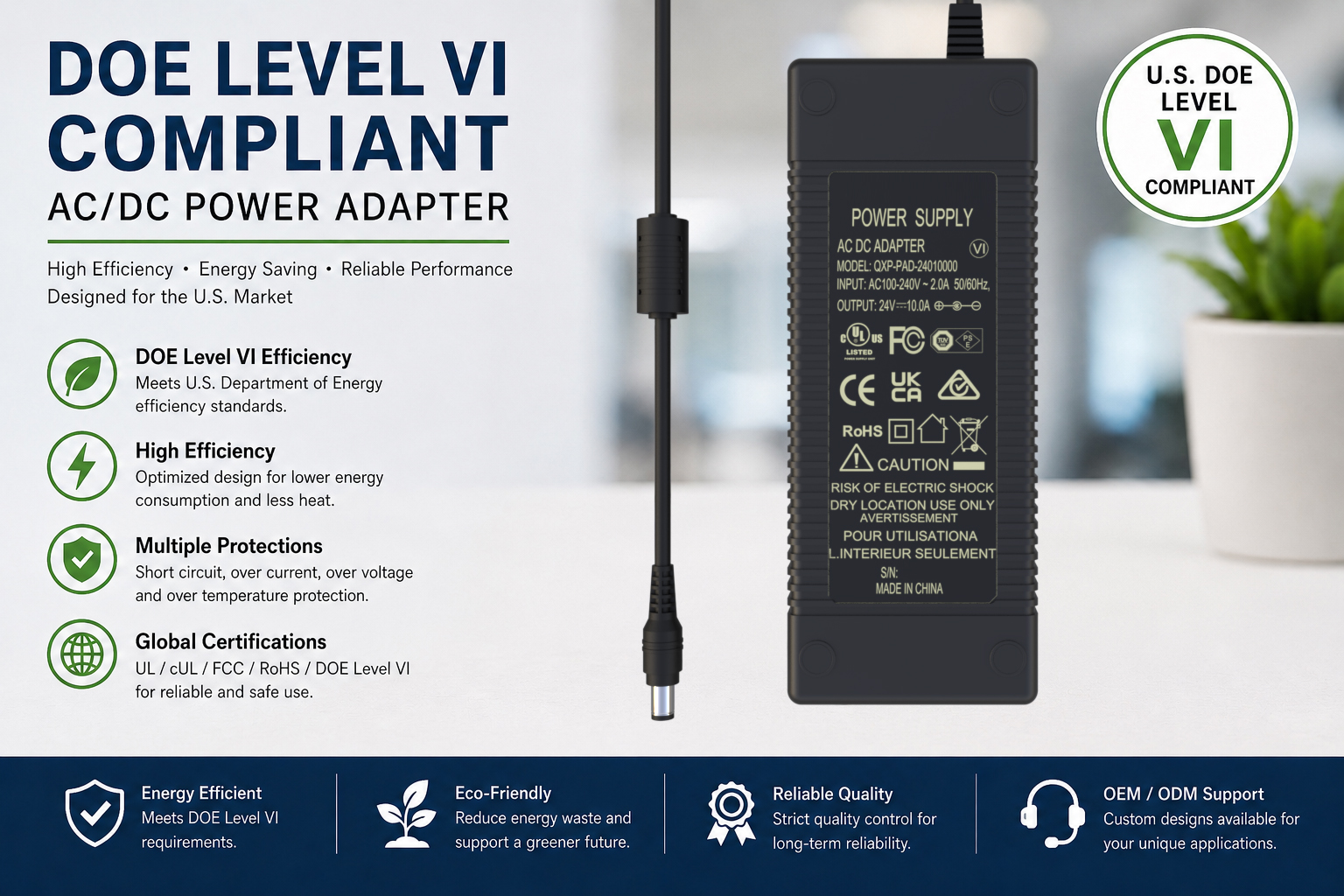
DOE Level VI is the sixth generation of external power supply efficiency regulations developed by the U.S. Department of Energy.
The regulation applies mainly to external AC/DC power supplies that convert household AC electricity into low-voltage DC power for electronic devices.
Common examples include:
The purpose of DOE Level VI is to ensure that external power supplies consume less electricity while maintaining reliable performance.
A traditional power adapter loses some energy during the conversion process. This lost energy is usually released as heat.
A more efficient adapter:
For manufacturers and buyers, DOE Level VI represents a balance between energy efficiency, performance, and regulatory compliance.
Before modern efficiency regulations were introduced, many external power supplies continued consuming electricity even when connected to a wall outlet without charging or powering a device.
This wasted energy became known as:
Although the power consumed by a single adapter may appear insignificant, the total impact becomes substantial when considering millions of electronic devices operating worldwide.
For example:
may remain connected to power adapters continuously.
The DOE introduced stricter efficiency requirements to address this issue.
The main objectives of DOE Level VI include:
More efficient power conversion reduces unnecessary electricity consumption.
Efficient designs generate less heat and experience lower thermal stress.
Lower energy consumption helps reduce overall carbon emissions.
Energy-efficient products help reduce electricity costs throughout the product lifecycle.
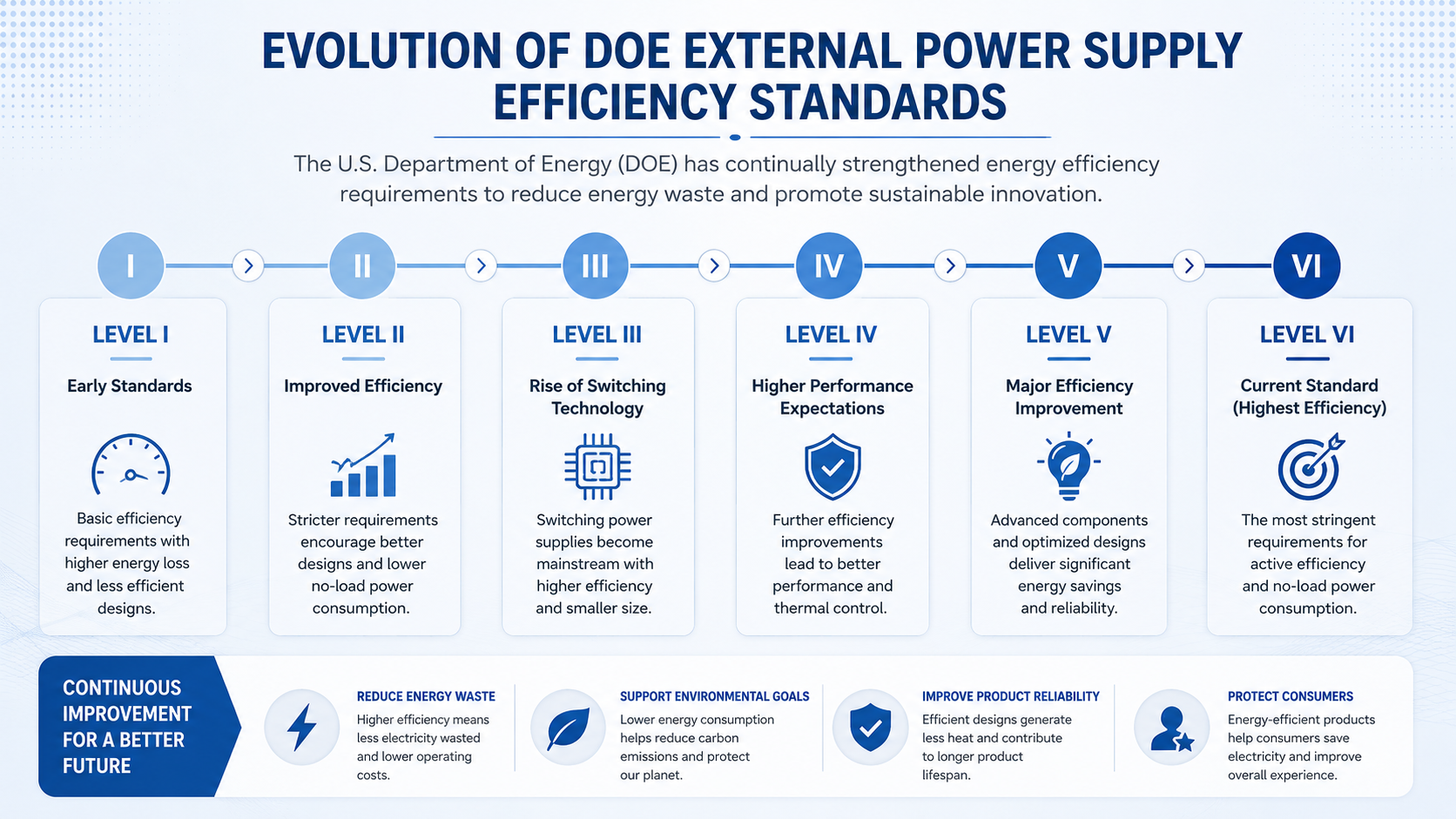
Understanding the development of DOE standards helps explain why Level VI became necessary.
The U.S. Department of Energy gradually introduced stricter requirements as technology improved.
Early external power supplies had limited efficiency requirements.
Many older linear power adapters consumed significant energy and generated excessive heat.
Efficiency requirements became stricter, encouraging manufacturers to improve power conversion technology.
The industry began moving toward switching power supply technology.
Compared with traditional linear adapters, switching designs provided:
Efficiency requirements increased further, creating greater demand for improved circuit design.
DOE Level V became widely adopted in the industry and represented a major improvement over previous generations.
Many manufacturers redesigned products with:
However, technology continued developing, and additional improvements became possible.
DOE Level VI introduced significantly stricter requirements, especially regarding:
Manufacturers were required to optimize power supply designs further.
DOE Level VI mainly applies to external power supplies used with electronic equipment.
Typical applications include:
Examples:
Examples:
Examples:
Examples:
Many external battery chargers must also consider DOE efficiency requirements.
For example:
Companies sourcing Battery Chargers for the U.S. market should confirm whether the product configuration falls within DOE regulations.
Not every power supply automatically falls under DOE Level VI requirements.
Certain products may have different requirements or exemptions depending on:
Examples may include specialized industrial systems or integrated power supplies.
Because regulations can vary depending on application, manufacturers and importers should confirm compliance requirements before production.
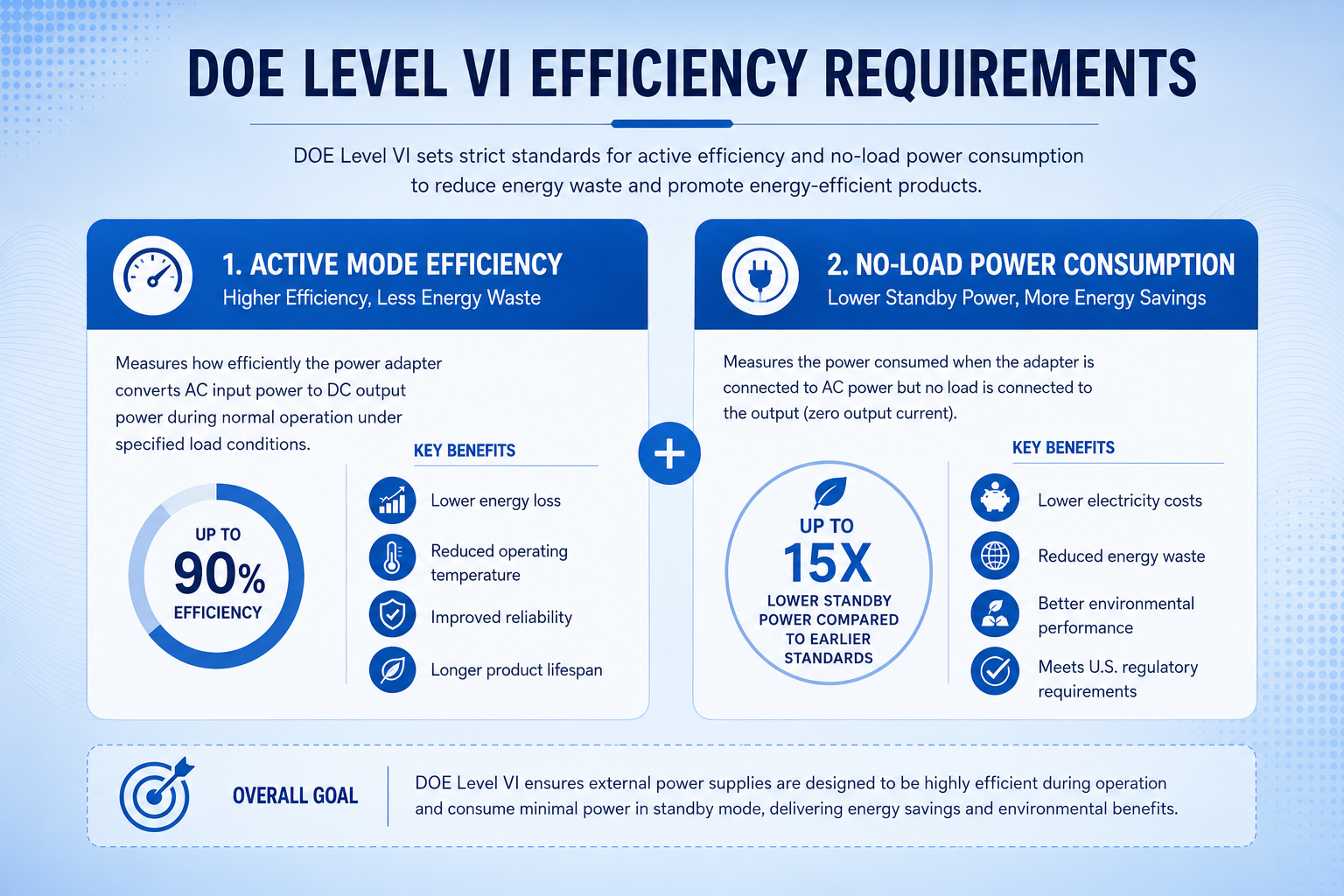
DOE Level VI focuses mainly on two important performance areas:
Both measurements determine how efficiently an external power supply uses electricity.
A power adapter is not considered energy efficient simply because it provides stable output power. It must also minimize energy loss during normal operation and standby conditions.
Active efficiency refers to how efficiently a power adapter converts AC input electricity into DC output power while operating under load conditions.
The basic principle is:
Higher conversion efficiency = Less wasted energy
During operation, energy losses usually occur through:
A high-quality DOE Level VI power adapter uses optimized circuit designs to reduce these losses.
Common design improvements include:
For example, a low-quality adapter may convert more energy into heat, while an efficient design transfers a larger percentage of input energy into usable DC output.
One of the biggest improvements introduced by DOE Level VI is strict control of standby energy consumption.
No-load power consumption refers to the electricity consumed when:
Older adapters could consume noticeable standby power even when not being used.
DOE Level VI requires manufacturers to minimize this unnecessary consumption.
Reducing no-load power helps:
DOE Level VI compliance is not based only on manufacturer claims. Understanding different certification requirements is also important when selecting a power adapter supplier, including Power Adapter Safety Certifications.
Power adapters must be tested according to standardized procedures.
Testing evaluates important electrical performance parameters, including:
The power supply is tested under specified AC input conditions.
Typical evaluation includes:
The laboratory measures efficiency at different load conditions.
The test evaluates how much input power is converted into useful output power.
The general formula is:
Efficiency (%) = Output Power ÷ Input Power × 100%
A higher percentage indicates better energy conversion performance.
The adapter is tested without an external load connected.
The laboratory measures standby power consumption and confirms whether it meets DOE Level VI requirements.
Although DOE Level VI focuses on efficiency, thermal performance is also important during product development.
Lower energy loss normally results in:
Many OEM buyers focus only on:
However, compliance should be considered equally important.
Choosing an unverified supplier may create risks such as:
Professional manufacturers maintain complete technical documentation, including:
A compliant power adapter normally includes product information on the label.
Typical label details include:
The DOE efficiency mark is usually represented by:
Level VI
This marking allows distributors and customers to identify compliant products more easily.
Many buyers ask:
"What is the difference between DOE Level V and DOE Level VI?"
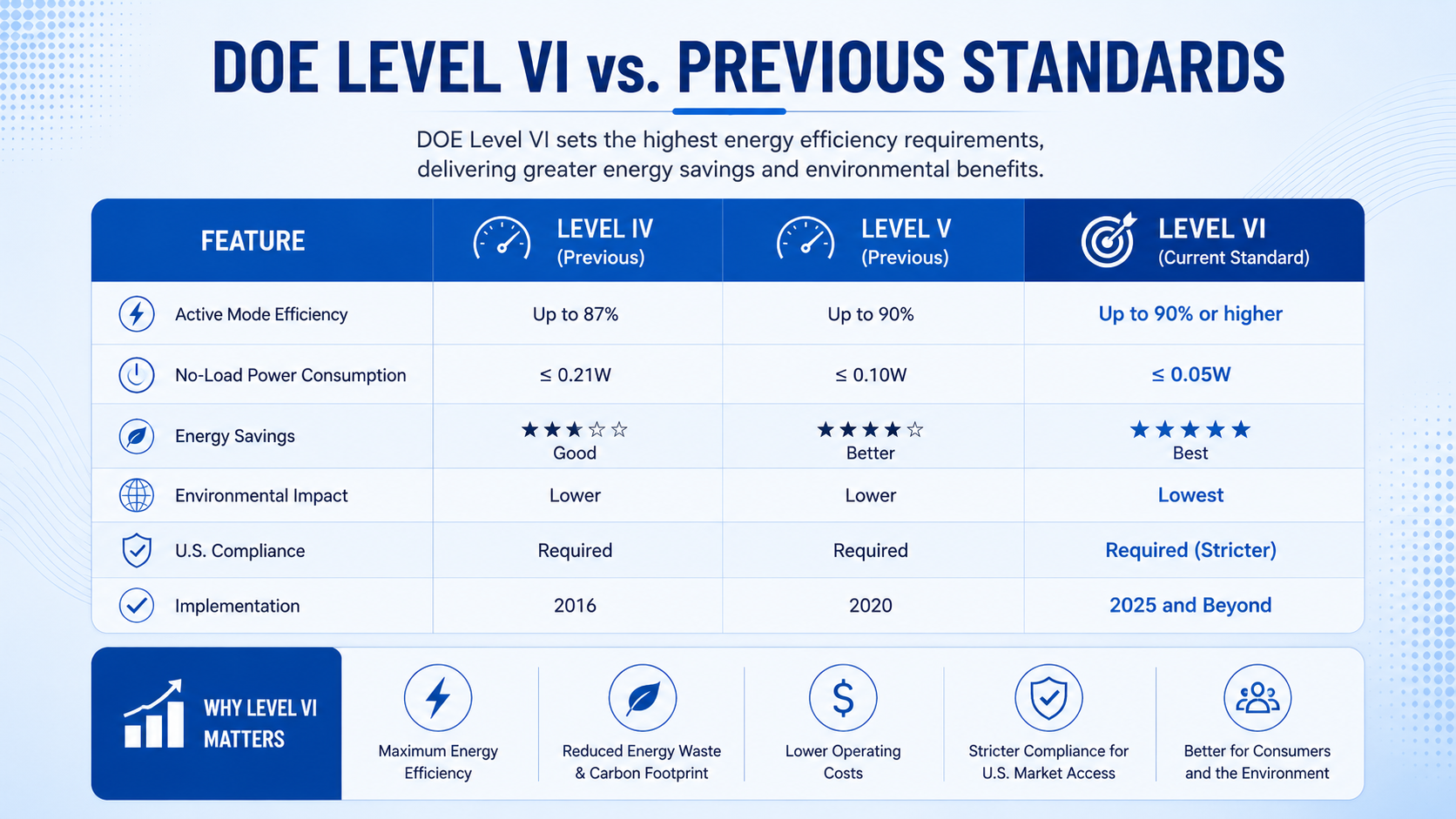
The main difference is that DOE Level VI introduced stricter efficiency requirements.
| Feature | DOE Level V | DOE Level VI |
|---|---|---|
| Efficiency requirement | Previous generation | Stricter requirement |
| Standby consumption | Improved | Lower |
| Energy savings | Good | Better |
| Design requirement | Standard switching design | More optimized design |
| Market requirement | Older standard | Current U.S. requirement |
Manufacturers needed to improve product designs to transition from Level V to Level VI.
Typical improvements included:
Another important energy regulation related to external power supplies is the California Energy Commission (CEC) efficiency requirement.
While DOE Level VI applies at the federal U.S. level, CEC regulations focus specifically on California requirements.
Both standards aim to:
For companies selling products throughout the United States, selecting power adapters that satisfy multiple efficiency standards can simplify compliance management.
European markets have similar energy efficiency regulations.
The European Union uses the ErP (Energy-related Products) framework to regulate energy-consuming products.
The goals are similar:
However, DOE Level VI and EU ErP are different regulations.
A product designed for global markets may require separate evaluation depending on the target country.
Manufacturers supporting international customers should understand regional requirements before production.
The EU Code of Conduct (CoC) Tier 2 represents another efficiency initiative for external power supplies.
Compared with DOE Level VI:
| Standard | Region | Main Focus |
|---|---|---|
| DOE Level VI | USA | External power supply efficiency |
| ErP | European Union | Energy-related product efficiency |
| CoC Tier 2 | Europe | Advanced efficiency targets |
For global OEM projects, selecting a supplier experienced with international standards can reduce development risks.
Many purchasing teams make mistakes when selecting external power supplies.
A power adapter may have the correct:
but still fail market requirements.
Always verify compliance documentation. Buyers should also consider electrical specifications, connector requirements, and application conditions when selecting products. Our guide on How To Choose The Right Power Adapter explains the key factors.
Safety certifications and efficiency certifications are different. Depending on the target market, OEM buyers may also need to consider environmental compliance requirements such as RoHS Compliance and other product regulations.
For example:
A product may require multiple certifications.
Low-cost suppliers may reduce:
A reliable manufacturer provides long-term value through stable quality and compliance support.
OEM buyers should evaluate suppliers based on:
Experienced manufacturers understand:
A professional supplier should support relevant certifications such as:
Custom projects often require:
Stable production requires:
As an experienced AC/DC power supply manufacturer, Guangdong QINX Technology Co.,LTD. develops and produces energy-efficient power solutions for global customers.
Our products include:
With output power ranging from 1W to 420W, Guangdong QINX supports applications including:
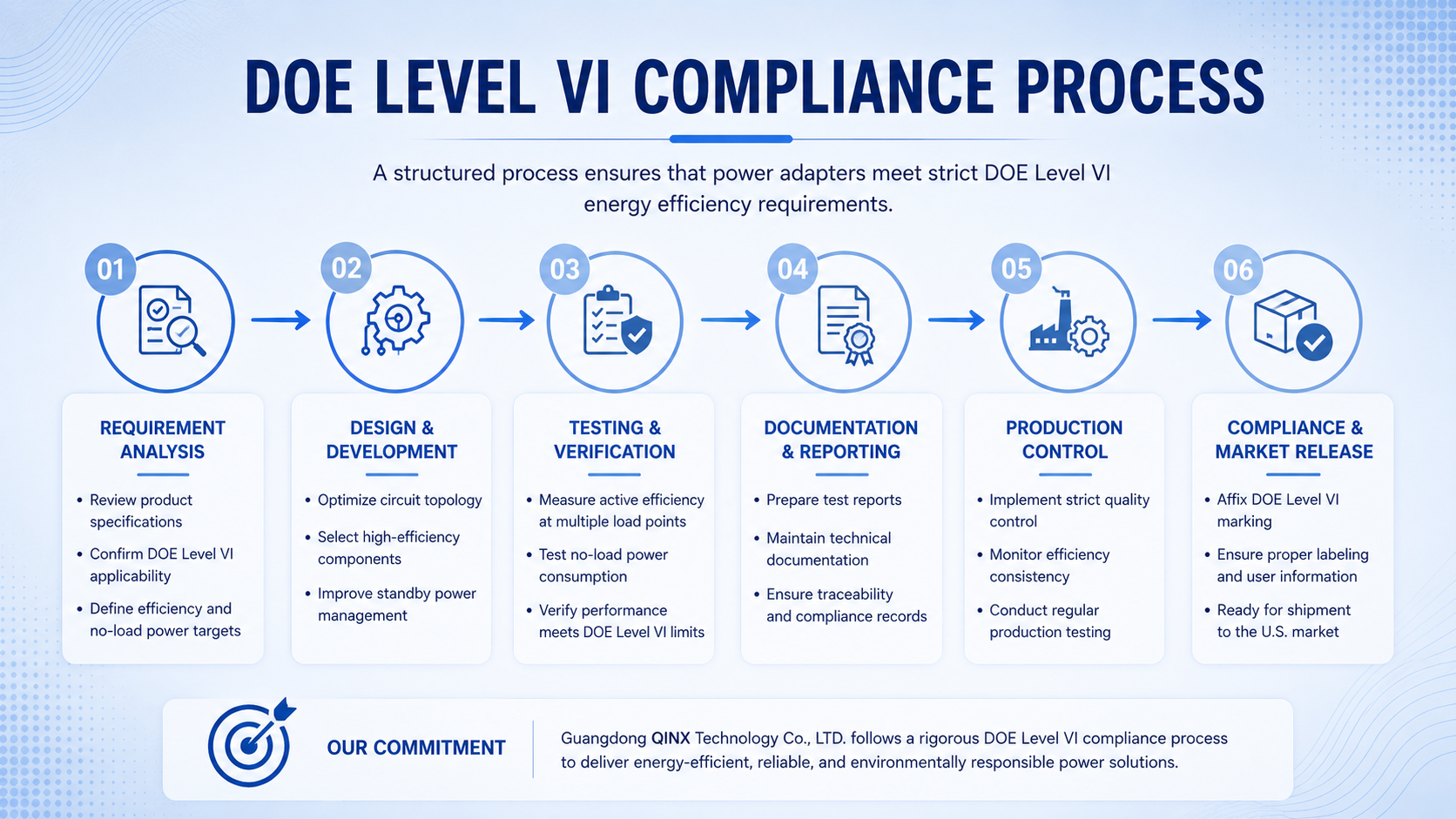
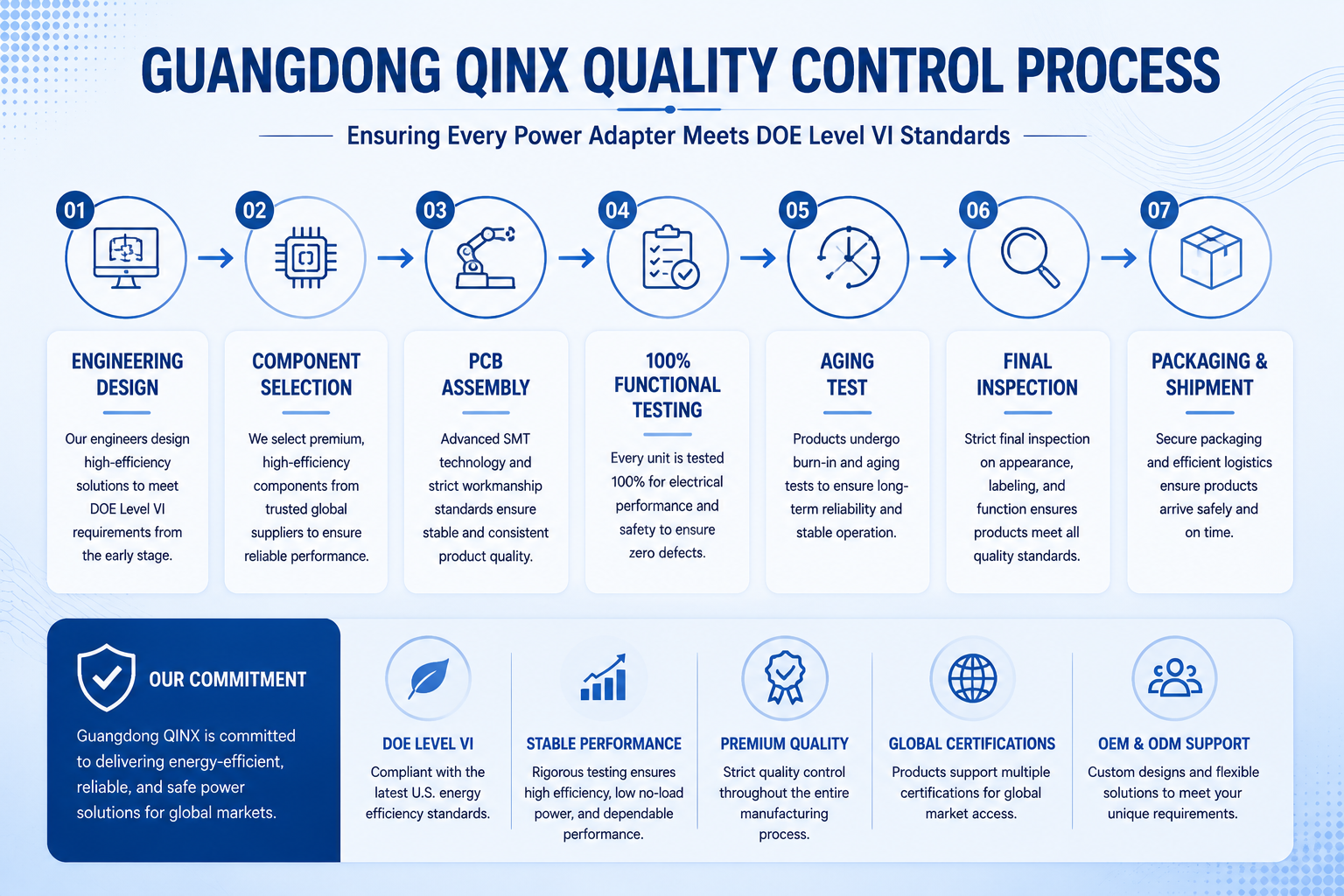
Energy efficiency compliance requires more than simply adding a marking to a product label. It requires careful engineering design, reliable components, strict testing procedures, and consistent manufacturing control.
At Guangdong QINX Technology Co.,LTD., DOE Level VI compliance is considered during every stage of product development, from initial circuit design to final production inspection.
As a professional manufacturer of AC/DC power adapters and battery chargers, Guangdong QINX focuses on creating reliable, efficient, and customized power solutions for global OEM customers.
Power efficiency starts from the internal design.
Guangdong QINX engineers optimize:
These improvements help reduce:
The result is a more efficient and reliable external power supply.
Component quality directly affects power adapter efficiency and reliability.
Guangdong QINX carefully evaluates:
High-quality components help maintain stable performance throughout the product lifecycle.
Before shipment, power adapters undergo multiple inspections and tests.
Typical testing includes:
These procedures help ensure every product meets customer specifications.
Different applications require different power solutions.
Guangdong QINX provides customized services including:
For companies requiring specialized designs, our OEM & Custom Power Supply Manufacturing service provides complete support from engineering development to mass production.
Selecting the right power supply manufacturer can significantly influence product success.
Global OEM customers choose Guangdong QINX because of:
Guangdong QINX specializes in:
Our product portfolio covers:
Power ranges from:
1W to 420W
allowing customers to select suitable solutions for different applications.
Different regions have different requirements.
Guangdong QINX supports products designed for markets including:
with certification support including:
Before purchasing an external power supply, buyers should confirm:
✔ Correct output voltage
✔ Correct output current
✔ Suitable connector type
✔ Required cable length
✔ Operating environment
✔ DOE Level VI efficiency compliance
✔ Safety certification requirements
✔ EMC requirements
✔ Environmental compliance
✔ Manufacturing experience
✔ Engineering support
✔ Testing capability
✔ Stable production capacity
✔ Documentation support
A reliable supplier should provide complete technical information before mass production.
DOE Level VI is an energy efficiency standard established by the U.S. Department of Energy for qualifying external power supplies.
It defines requirements for:
The goal is to reduce wasted electricity and improve power supply efficiency.
Yes, many external power supplies sold in the U.S. market must comply with DOE Level VI requirements.
Manufacturers and importers should confirm whether their specific product falls within the regulation scope.
No.
DOE Level VI and UL certification cover different areas.
DOE focuses on:
UL focuses on:
Many U.S. power adapters require both efficiency and safety compliance.
DOE Level VI introduced stricter efficiency requirements compared with Level V.
The main improvements include:
A compliant product normally includes:
Buyers should also request compliance documents from suppliers.
Many external battery chargers may need to consider DOE efficiency requirements depending on their design and application.
When sourcing Battery Chargers, OEM buyers should confirm compliance requirements with their supplier.
Not necessarily.
Requirements depend on:
Professional manufacturers can help determine applicable standards.
Indirectly.
Higher efficiency usually produces less heat, which can reduce thermal stress on internal components.
Lower operating temperatures may contribute to longer product life.
Yes.
Many manufacturers design products that support multiple markets.
However, each market may require separate certifications and testing.
Because compliance affects:
Selecting a compliant supplier reduces future risks.
Sometimes.
Higher efficiency designs may require:
However, the benefits often outweigh the initial cost through improved reliability and compliance.
DOE Level VI applies to many external power supplies across different power ranges.
Guangdong QINX manufactures power adapters from:
1W to 420W
for various applications.
Depending on the application, products may require:
Additional certifications may be required depending on the target market.
Yes.
Guangdong QINX supports OEM and custom projects including:
Consider:
Working with an experienced manufacturer helps ensure a successful project.
DOE Level VI represents an important step toward improving energy efficiency in external power supplies. By reducing standby consumption and improving conversion efficiency, it helps manufacturers create products that are more environmentally responsible, reliable, and cost-effective.
For OEM brands, distributors, and importers, selecting a DOE Level VI compliant power adapter supplier is essential for successful product development and market entry.
A professional supplier should provide:
With experience in AC/DC power adapter and charger manufacturing, Guangdong QINX Technology Co.,LTD. provides customized and reliable power solutions for global customers.
From standard DOE Level VI compliant adapters to fully customized OEM projects, Guangdong QINX helps businesses develop efficient power solutions for modern electronic applications.
Explore our AC/DC Power Adapters and contact Guangdong QINX for customized power solutions.


