
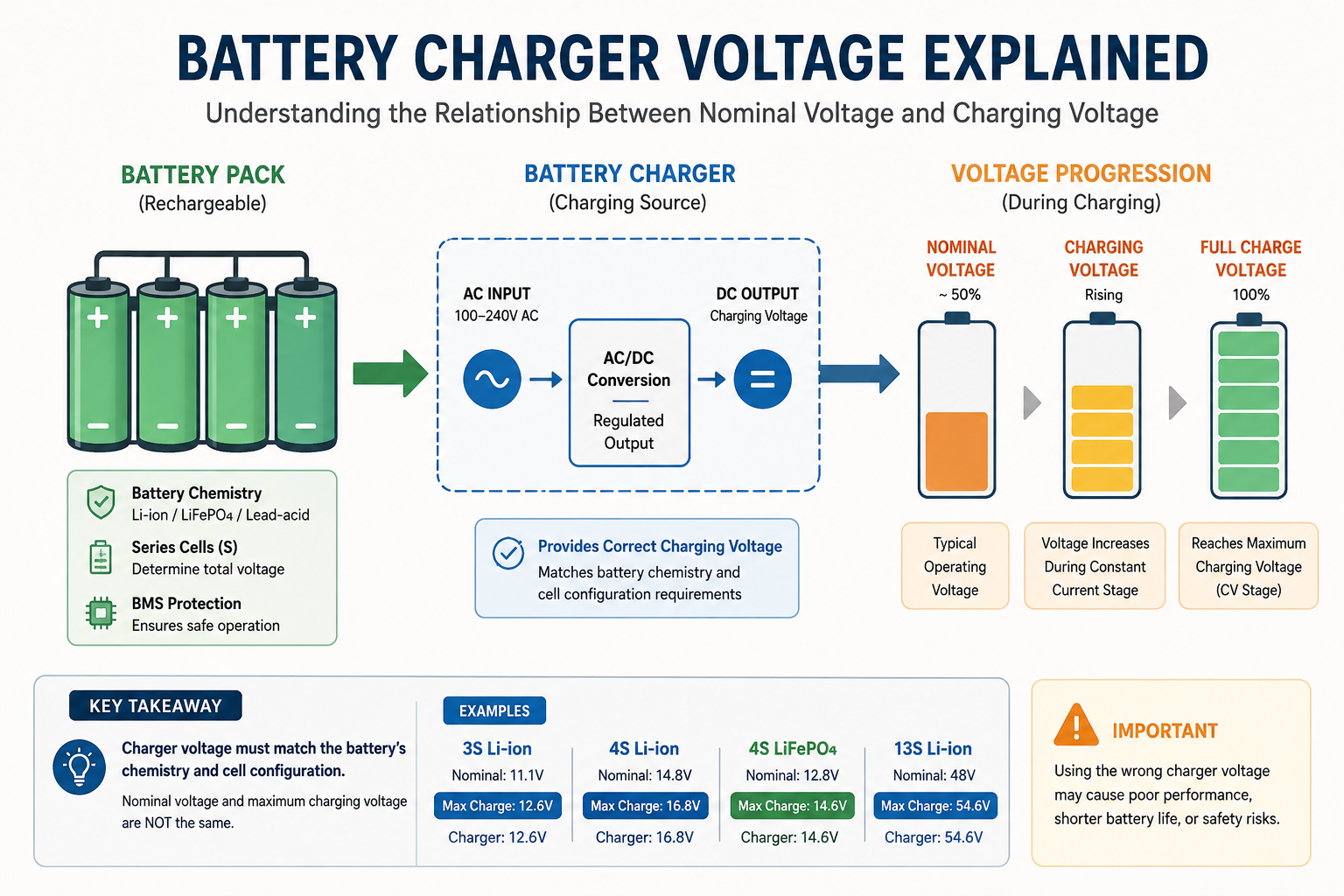
Choosing the correct battery charger voltage is one of the most important steps when charging a rechargeable battery. A charger with the wrong output voltage may fail to charge the battery properly, reduce battery life, trigger protection circuits, or create serious safety risks.
However, battery voltage can be confusing because a battery may have a nominal voltage, an actual voltage during operation, and a maximum charging voltage. These values are related, but they are not the same.
For example, a lithium-ion battery pack commonly described as a “12V battery” may actually require a 12.6V charger. Similarly, a 12V LiFePO4 battery normally requires a charger with a higher output voltage, typically 14.6V, because LiFePO4 cells have a different voltage profile and charging requirement.
Understanding these differences is essential for consumers, engineers, equipment manufacturers, and purchasing teams selecting a battery charger.
In this guide, Guangdong QINX Technology Co., Ltd. explains how battery charger voltage works, why different battery chemistries require different charging voltages, how battery pack voltage is calculated, and how to choose the correct charger voltage for a specific application.
Battery charger voltage is the DC output voltage that a charger provides to a battery during the charging process.
The charger must provide a suitable voltage level that allows current to flow into the battery while remaining within the battery manufacturer's specified charging limits.
A simple way to understand the relationship is:
AC input → Battery charger → DC charging voltage → Battery
For example, an AC/DC battery charger may receive 100–240V AC from the mains and convert it into a regulated DC output such as:
12.6V DC
14.6V DC
16.8V DC
21V DC
29.4V DC
42V DC
54.6V DC
58.8V DC
The correct output voltage depends primarily on the battery chemistry and the number of cells connected in series.
This is why choosing a charger based only on the number printed on a battery can be misleading.
One of the most common mistakes when selecting a battery charger is assuming that the battery's nominal voltage should exactly match the charger's output voltage.
In many rechargeable battery systems, this is not correct.
Nominal voltage is a convenient reference value used to describe the approximate operating voltage of a battery or battery pack.
For example, a lithium-ion battery cell is commonly described as a 3.6V or 3.7V nominal cell.
But a typical lithium-ion cell does not remain at exactly 3.7V.
Its voltage changes depending on its state of charge.
A simplified example is:
Fully discharged: approximately 2.5–3.0V, depending on the cell specification
Nominal voltage: approximately 3.6–3.7V
Fully charged: approximately 4.2V
Therefore, a battery pack made from three lithium-ion cells connected in series is commonly called a 12V battery, even though its maximum charging voltage is approximately 12.6V.
Three lithium-ion cells connected in series can be represented as:
3 × 3.7V = 11.1V nominal
But the maximum charging voltage is:
3 × 4.2V = 12.6V
Therefore, a suitable charger for this battery configuration is typically a 12.6V lithium-ion battery charger, assuming the battery manufacturer specifies a 4.2V-per-cell charging limit.
This distinction between nominal voltage and maximum charging voltage is fundamental to understanding battery charger selection.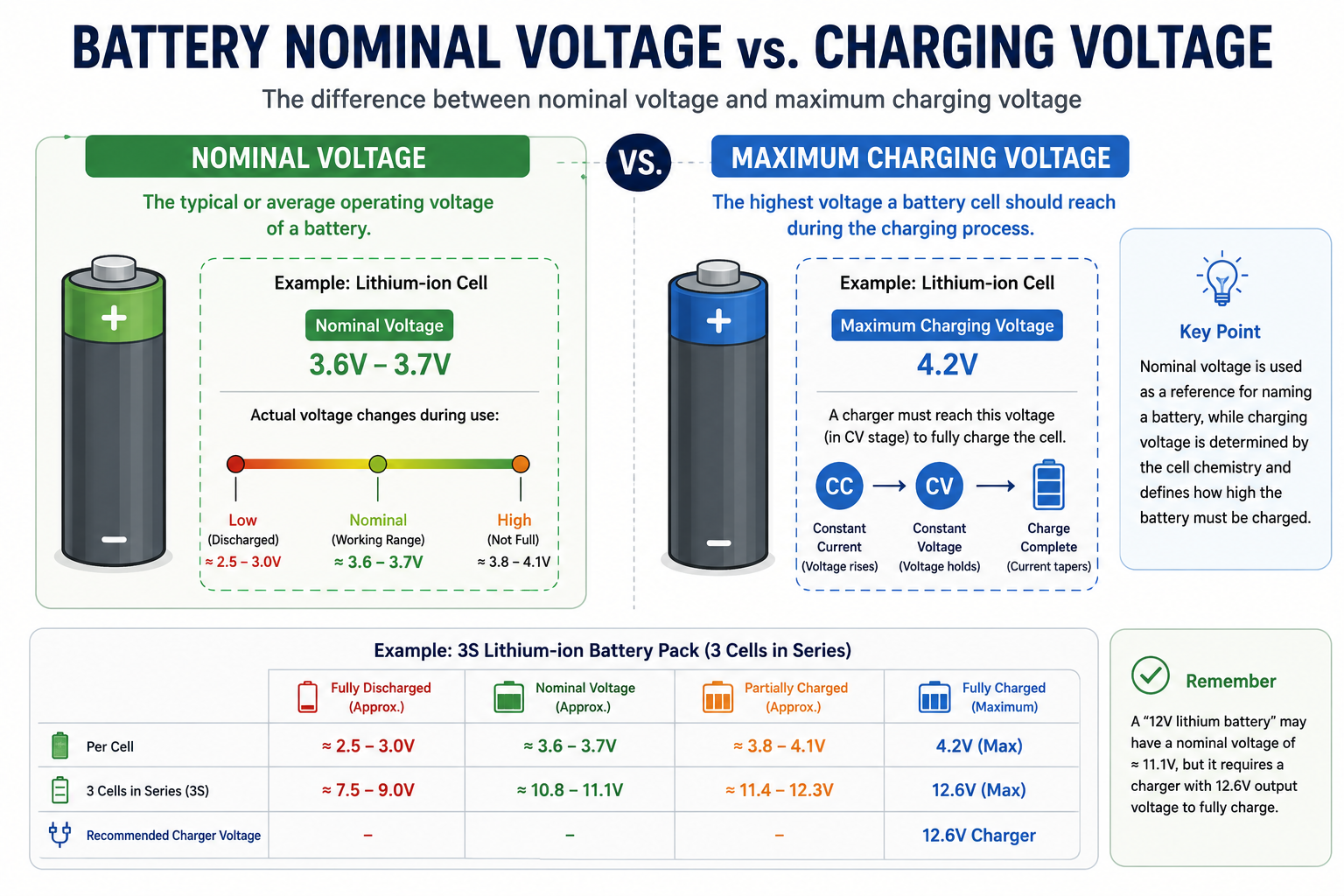
Battery charger voltage cannot be selected based on voltage alone.
The battery chemistry determines the appropriate charging voltage and charging method.
Different rechargeable battery chemistries have different electrochemical characteristics. As a result, a charger designed for one battery chemistry should not automatically be used with another chemistry simply because the nominal voltage appears similar.
Common rechargeable battery types include:
Lithium-ion
LiFePO4
Lead-acid
Other lithium-based battery chemistries
For lithium battery applications, charging voltage is particularly important because lithium cells typically have a defined maximum voltage that should not be exceeded.
For a deeper introduction to lithium charging technologies, see our Lithium Battery Charger Guide.
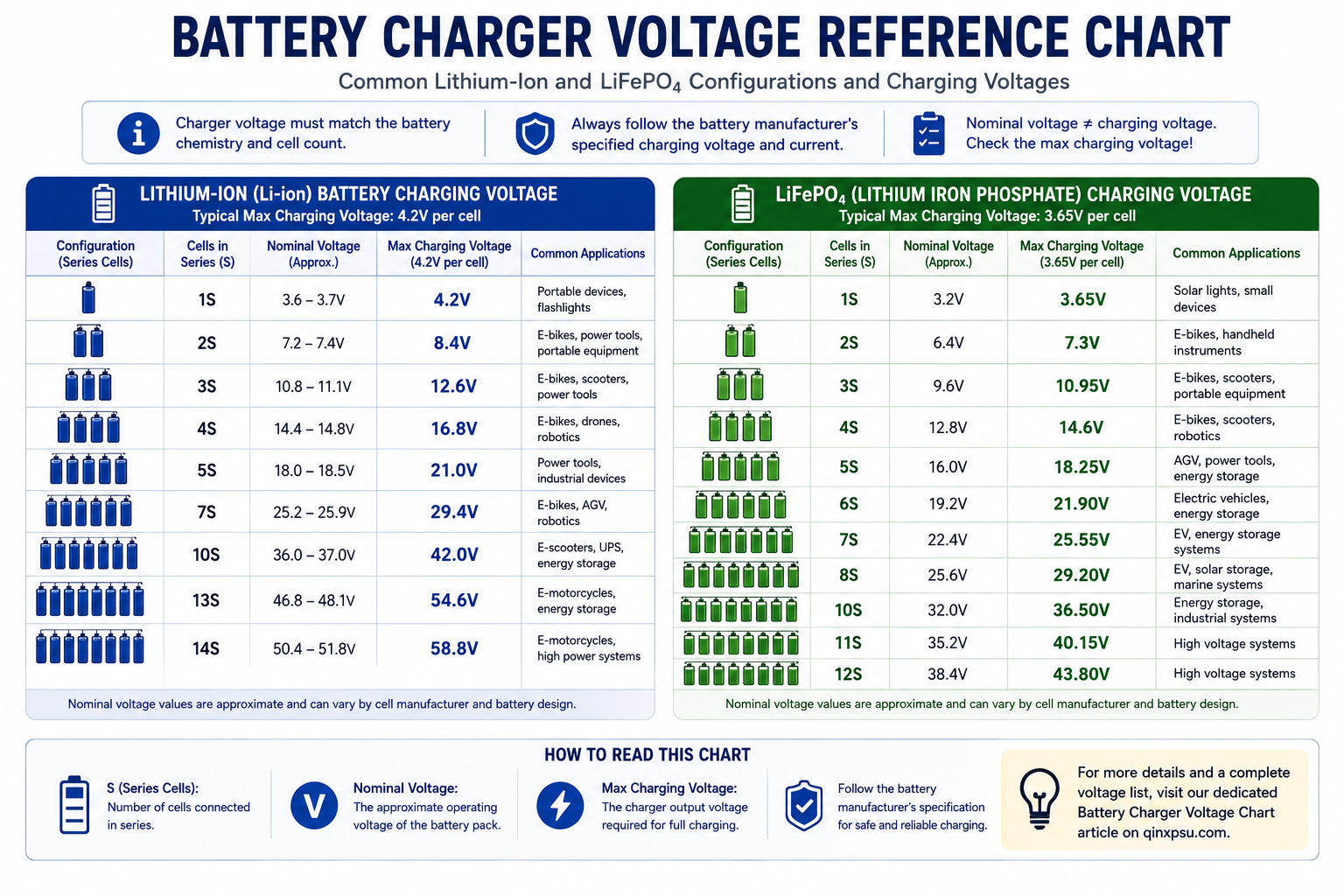
Lithium-ion batteries are commonly built using cells with a nominal voltage of approximately 3.6–3.7V and a maximum charging voltage of approximately 4.2V per cell, depending on the specific cell chemistry and manufacturer specification.
The number of cells connected in series determines the battery pack voltage.
For example:
| Lithium-Ion Configuration | Nominal Voltage | Maximum Charging Voltage |
|---|---|---|
| 1S | 3.6–3.7V | 4.2V |
| 2S | 7.2–7.4V | 8.4V |
| 3S | 10.8–11.1V | 12.6V |
| 4S | 14.4–14.8V | 16.8V |
| 5S | 18.0–18.5V | 21.0V |
| 7S | 25.2–25.9V | 29.4V |
| 10S | 36.0–37.0V | 42.0V |
| 13S | 46.8–48.1V | 54.6V |
| 14S | 50.4–51.8V | 58.8V |
The exact nominal voltage can vary by cell specification, but the charging voltage is determined by the specified maximum voltage per cell multiplied by the number of series cells.
Some commonly encountered lithium-ion charging voltages include:
4.2V, 8.4V, 12.6V, 16.8V, 21V, 29.4V, 42V, 54.6V and 58.8V.
These numbers are important search terms for battery charger buyers because they correspond to common lithium-ion battery pack configurations.
However, the charger voltage should always be confirmed against the battery manufacturer's specification rather than selected solely from a generic voltage table.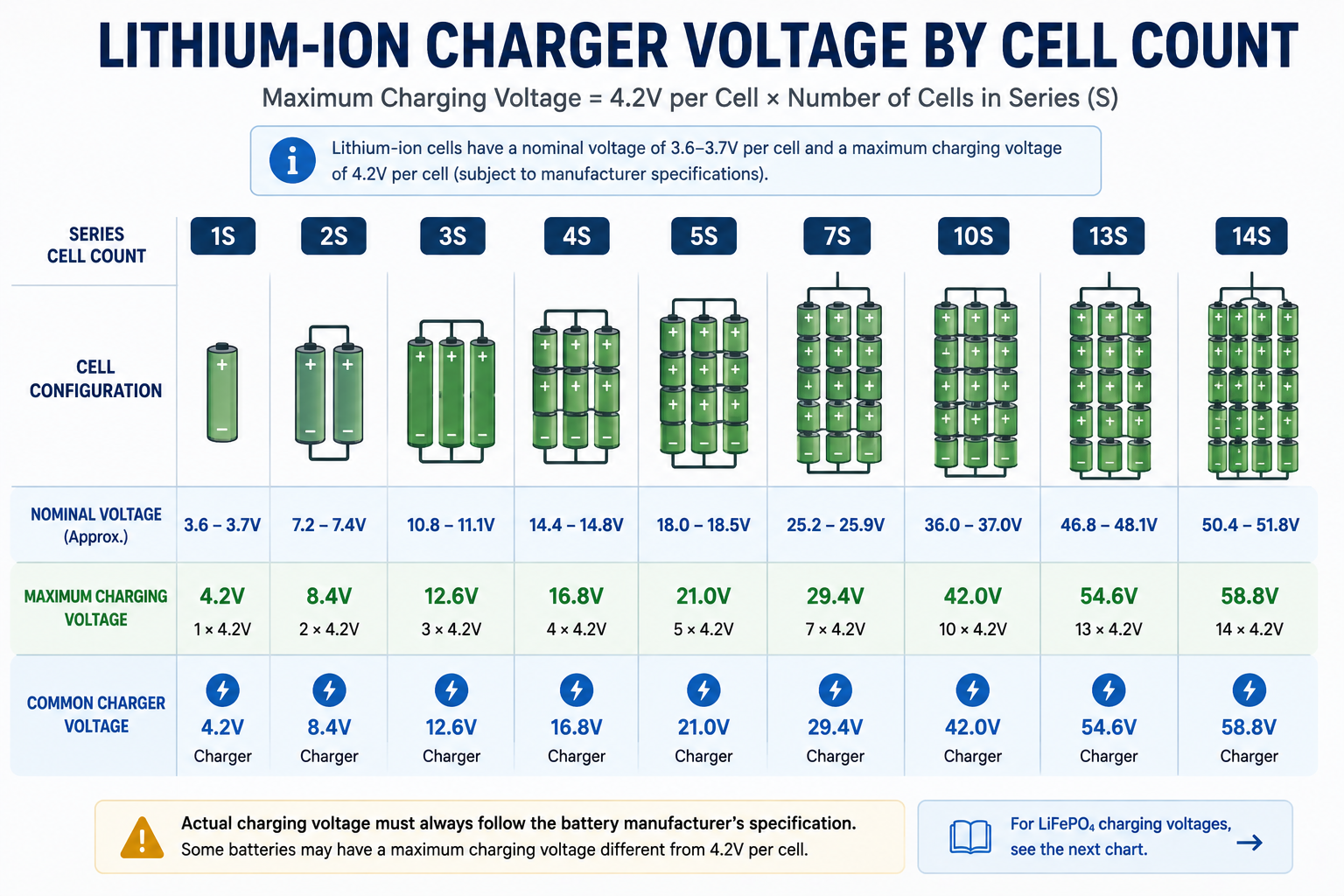
LiFePO4, or lithium iron phosphate, is another widely used rechargeable battery chemistry.
LiFePO4 cells have a different nominal voltage and charging voltage from conventional lithium-ion cells.
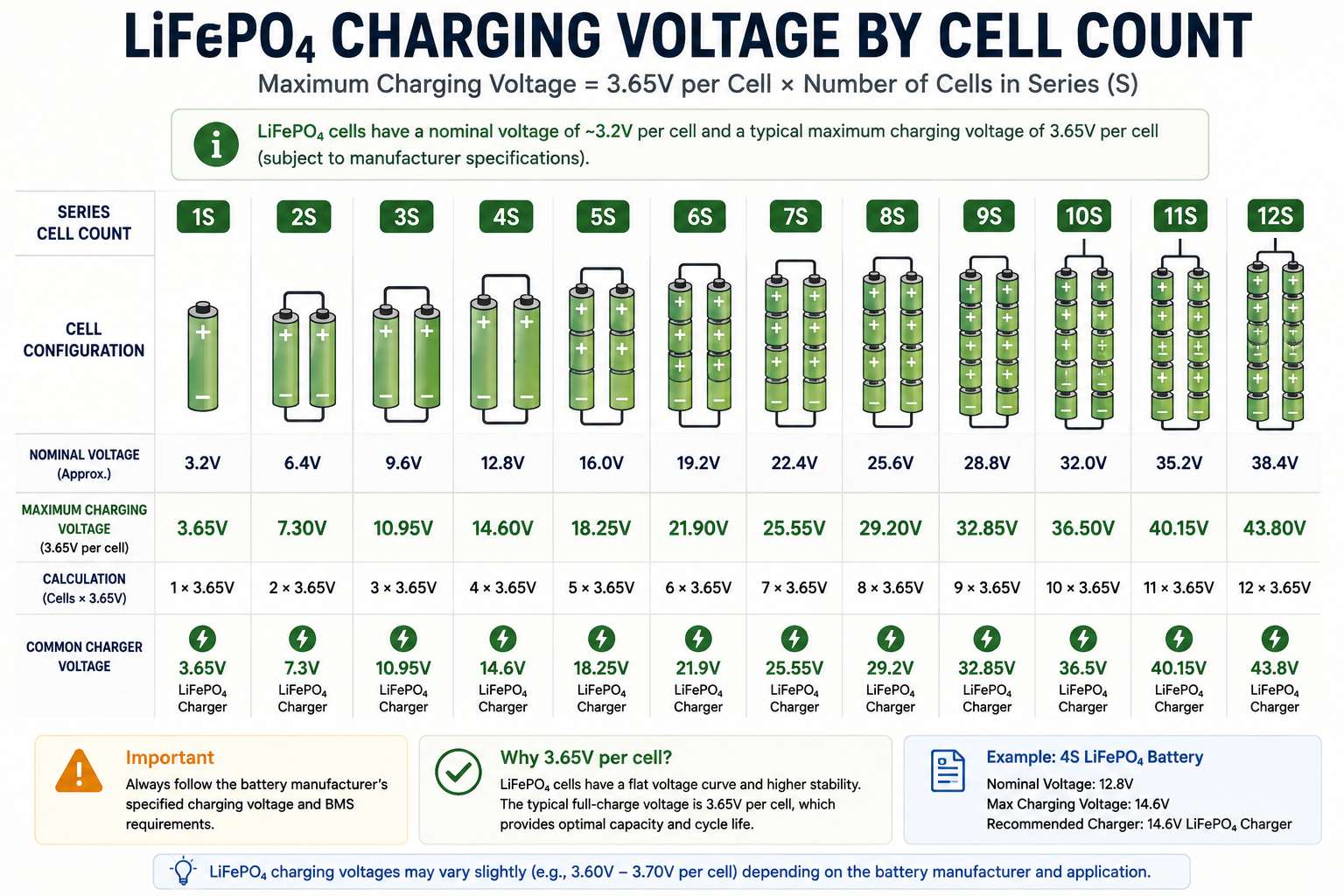
A LiFePO4 cell is commonly described as approximately 3.2V nominal, while the typical maximum charging voltage is approximately 3.65V per cell, subject to the battery manufacturer's specifications.
For a 4S LiFePO4 battery:
4 × 3.65V = 14.6V
Therefore, a battery commonly described as a 12V LiFePO4 battery generally uses a 14.6V charger when the battery specification calls for 3.65V per cell.
This is one of the clearest examples of why nominal battery voltage and charger voltage are not interchangeable.
Typical LiFePO4 charger voltage examples include:
3.65V for 1S
7.3V for 2S
10.95V for 3S
14.6V for 4S
18.25V for 5S
21.9V for 6S
25.55V for 7S
29.2V for 8S
32.85V for 9S
36.5V for 10S
40.15V for 11S
43.8V for 12S
Actual charging requirements should always follow the battery pack and BMS manufacturer's specifications.
For applications requiring different lithium chemistries, see our LiFePO4 Charger vs Lithium-Ion Charger guide.
Lead-acid batteries work differently from lithium batteries.
A conventional 12V lead-acid battery is commonly composed of six cells, with a nominal voltage of approximately 12V. However, its charging voltage is higher than 12V.
Depending on battery type, charging stage, temperature, and manufacturer recommendations, a 12V lead-acid battery may require a charging voltage in the approximate range of the mid-14V range during the main charging phase.
This means a generic “12V power supply” should not automatically be treated as a suitable 12V lead-acid battery charger.
Lead-acid batteries can also require multiple charging stages, such as bulk, absorption, and float charging.
This is different from simply providing a fixed DC voltage.
For this reason, battery charger voltage and charging algorithm should be considered together.
One of the most useful concepts for understanding battery charger voltage is the number of cells connected in series.
When cells are connected in series, their voltages add together.
The basic relationship is:
Battery Pack Voltage = Cell Voltage × Number of Series Cells
For the charging limit:
Maximum Charging Voltage = Maximum Cell Charging Voltage × Number of Series Cells
For example, suppose a lithium-ion battery uses three cells in series.
If each cell has:
3.7V nominal voltage
4.2V maximum charging voltage
Then:
Nominal pack voltage = 3 × 3.7V = 11.1V
Maximum charging voltage = 3 × 4.2V = 12.6V
The battery may therefore be marketed as a “12V lithium battery,” while its charger is specified as a 12.6V battery charger.
This principle can be applied to many other battery configurations.
If the charger's output voltage is below the battery's required charging voltage, several problems can occur.
The charger may be unable to reach the required final charging voltage.
For example, using a 12V fixed-output power supply for a battery requiring 12.6V charging voltage may result in incomplete charging.
A charger may reach its voltage limit before the battery reaches its intended state of charge.
The charging process may become inefficient or take significantly longer than expected.
If a battery cannot reach its intended full-charge voltage, the available usable capacity may be lower than expected.
However, using a lower voltage is not necessarily a safe substitute for a correctly designed charger. The charger must also use an appropriate charging profile.
A charger with an excessive output voltage can be much more serious.
If the voltage exceeds the battery manufacturer's specified charging limit, the battery may experience:
Overvoltage stress
Excessive heating
Protection circuit activation
Reduced battery life
Charging failure
In severe cases, battery damage or a safety hazard
Lithium batteries are particularly sensitive to overvoltage.
A battery management system (BMS) may provide protection against certain abnormal conditions, but a BMS should not be treated as permission to use the wrong charger.
The charger should still be designed for the battery's chemistry, cell count, voltage, current, and charging requirements.
Not necessarily.
A standard AC/DC power adapter and a battery charger can look similar externally, but their functions may be different.
A power adapter generally provides regulated DC power to an electronic device.
A battery charger is designed to control the charging process according to the requirements of a battery.
For example, a power adapter may provide a stable 12V output to an electronic device, while a lithium battery charger may provide a specific charging voltage and current profile.
This distinction becomes especially important when designing equipment that contains a rechargeable battery.
Learn more about the difference between these two categories in AC/DC Power Adapter vs Battery Charger: What's the Difference?.
Many lithium battery chargers use a CC/CV charging method, meaning Constant Current followed by Constant Voltage.
During the constant-current phase, the charger supplies a controlled charging current while battery voltage gradually increases.
Once the battery reaches the specified charging voltage, the charger transitions into the constant-voltage phase.
During the constant-voltage phase, the charger maintains the specified voltage while charging current gradually decreases.
For example, a suitable 12.6V lithium-ion charger may:
Provide controlled charging current.
Allow battery voltage to increase.
Reach approximately 12.6V.
Maintain the voltage within the specified limit.
Allow charging current to taper as the battery approaches full charge.
Terminate or transition according to the charger's design.
This is why simply using a fixed-voltage power supply is not always equivalent to using a properly designed battery charger.
For a detailed explanation, see CC CV Charging Explained.
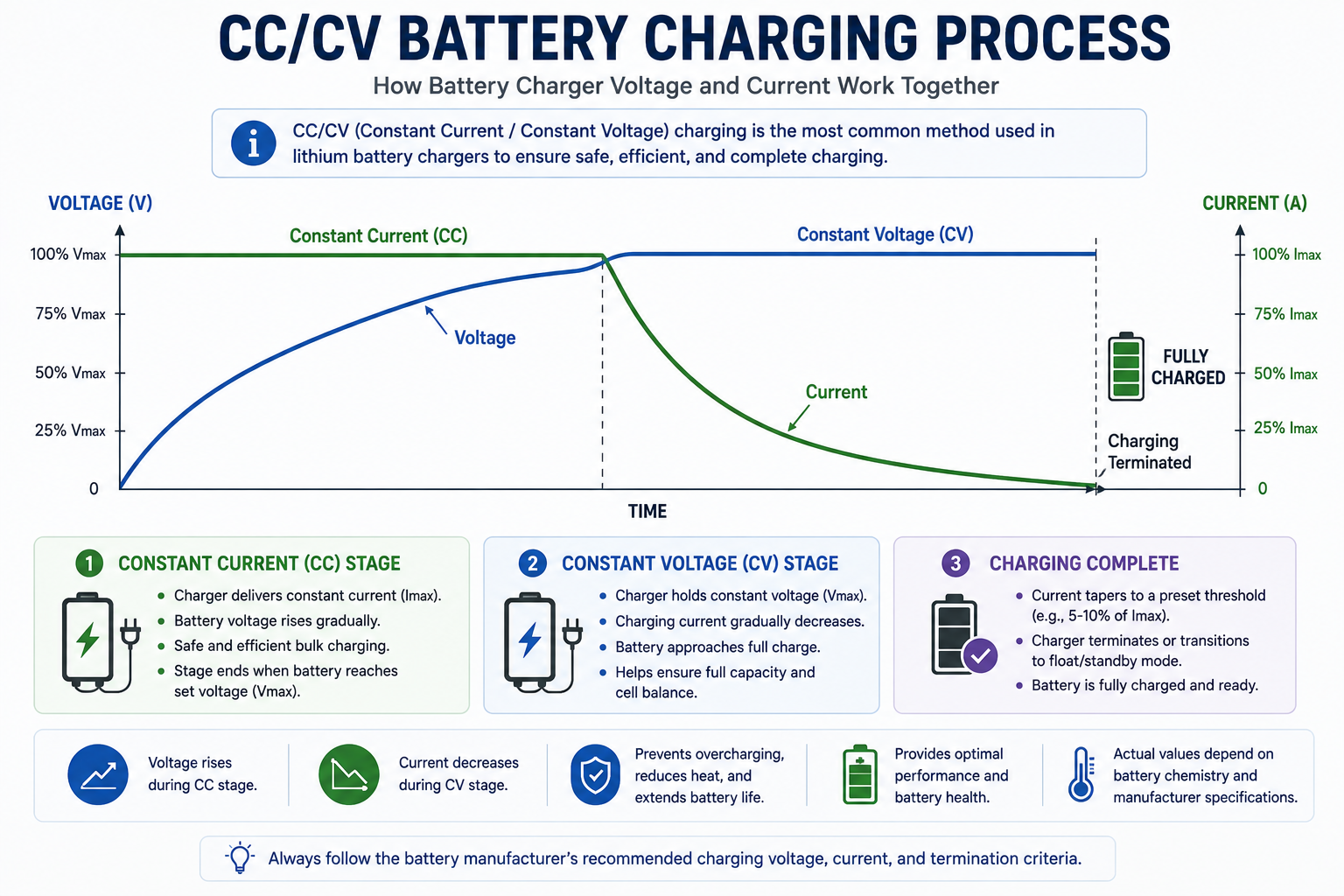
Charging voltage also changes in relation to the charging stage.
A battery may begin charging at a relatively low voltage and gradually approach its maximum charging voltage.
A typical lithium charging process can be simplified into:
Battery connected → Constant Current → Constant Voltage → Current decreases → Charging complete
The exact control strategy depends on battery chemistry, battery pack design, charger design, and battery management electronics.
Understanding charging stages helps explain why the charger's rated voltage is not necessarily the same as the battery's voltage throughout the entire charging process.
You can learn more about the overall process in Battery Charging Stages Explained.
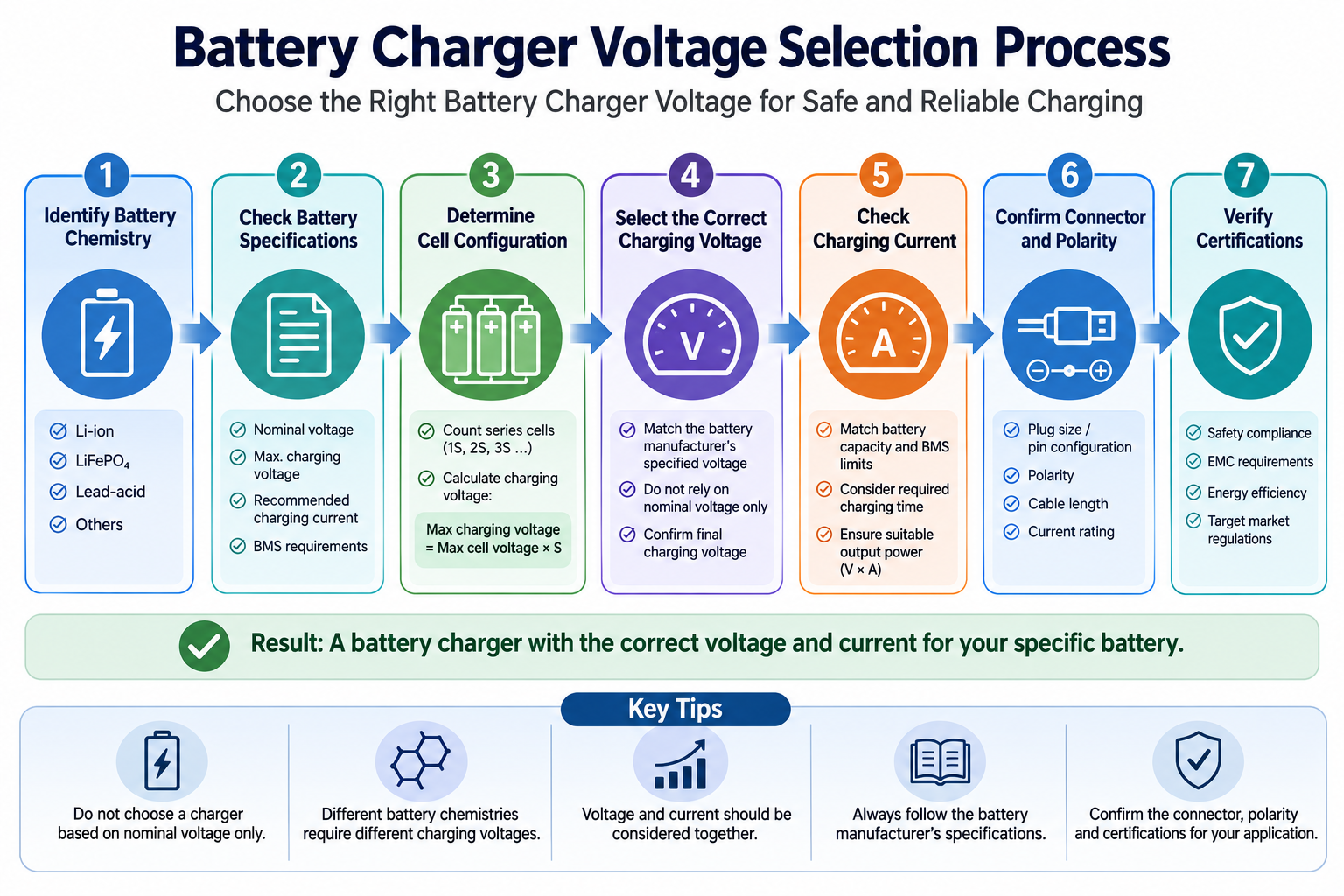
When selecting a battery charger, do not start with the charger.
Start with the battery.
Determine whether the battery is:
Lithium-ion
LiFePO4
Lead-acid
Another chemistry
Do not assume that two batteries with the same nominal voltage require the same charger.
Look for information such as:
Nominal voltage
Maximum charging voltage
Recommended charging current
Battery chemistry
Number of cells
BMS requirements
Recommended charger
The manufacturer's specifications should take priority over generic online voltage charts.
For lithium battery packs, determine how many cells are connected in series.
For example:
3S lithium-ion → 12.6V maximum charging voltage
4S LiFePO4 → 14.6V maximum charging voltage
Choose a charger whose output voltage matches the battery manufacturer's specified charging voltage.
Do not select a charger simply because its output voltage “looks close.”
Voltage is only one part of charger selection.
The charger's current rating also needs to be appropriate for the battery and application.
For example, two chargers may both output 14.6V but provide different charging currents.
A 14.6V 2A charger and a 14.6V 10A charger are not interchangeable for every application.
The appropriate current depends on battery capacity, battery specifications, thermal conditions, BMS limitations, and the required charging time.
The charger's DC connector must be mechanically and electrically compatible with the battery system.
Important specifications include:
Plug dimensions
Pin configuration
Polarity
Cable length
Connector current rating
A charger with the correct voltage can still be unsuitable if its connector or polarity is wrong.
For more information about connector selection, see Common DC Connector Types Explained.
For commercial products, charger certification can also be an important purchasing consideration.
Depending on the target market, requirements may include certifications or compliance relating to electrical safety, EMC, energy efficiency, and environmental regulations.
For OEM projects, certification requirements should ideally be considered during the design stage rather than after the charger has already been developed.
The following examples illustrate how nominal battery voltage and charging voltage can differ.
Battery:
3S lithium-ion
Typical nominal voltage:
11.1V
Typical maximum charging voltage:
12.6V
Suitable charger voltage:
12.6V, when specified for that battery.
Battery:
4S lithium-ion
Nominal voltage:
14.8V
Maximum charging voltage:
16.8V
Suitable charger voltage:
16.8V, subject to the battery manufacturer's specification.
Battery:
4S LiFePO4
Nominal voltage:
12.8V
Maximum charging voltage:
14.6V
Suitable charger:
14.6V LiFePO4 charger
This example demonstrates why a “12V lithium battery” does not automatically mean that every 12V lithium chemistry uses the same charger.
Battery:
10S lithium-ion
Nominal voltage:
approximately 36–37V
Maximum charging voltage:
42V
Suitable charger:
42V lithium-ion battery charger, assuming the battery is specified for 4.2V maximum charging voltage per cell.
Battery:
13S lithium-ion
Nominal voltage:
approximately 48V
Maximum charging voltage:
54.6V
Suitable charger:
54.6V lithium-ion battery charger
This configuration is common in higher-voltage battery systems.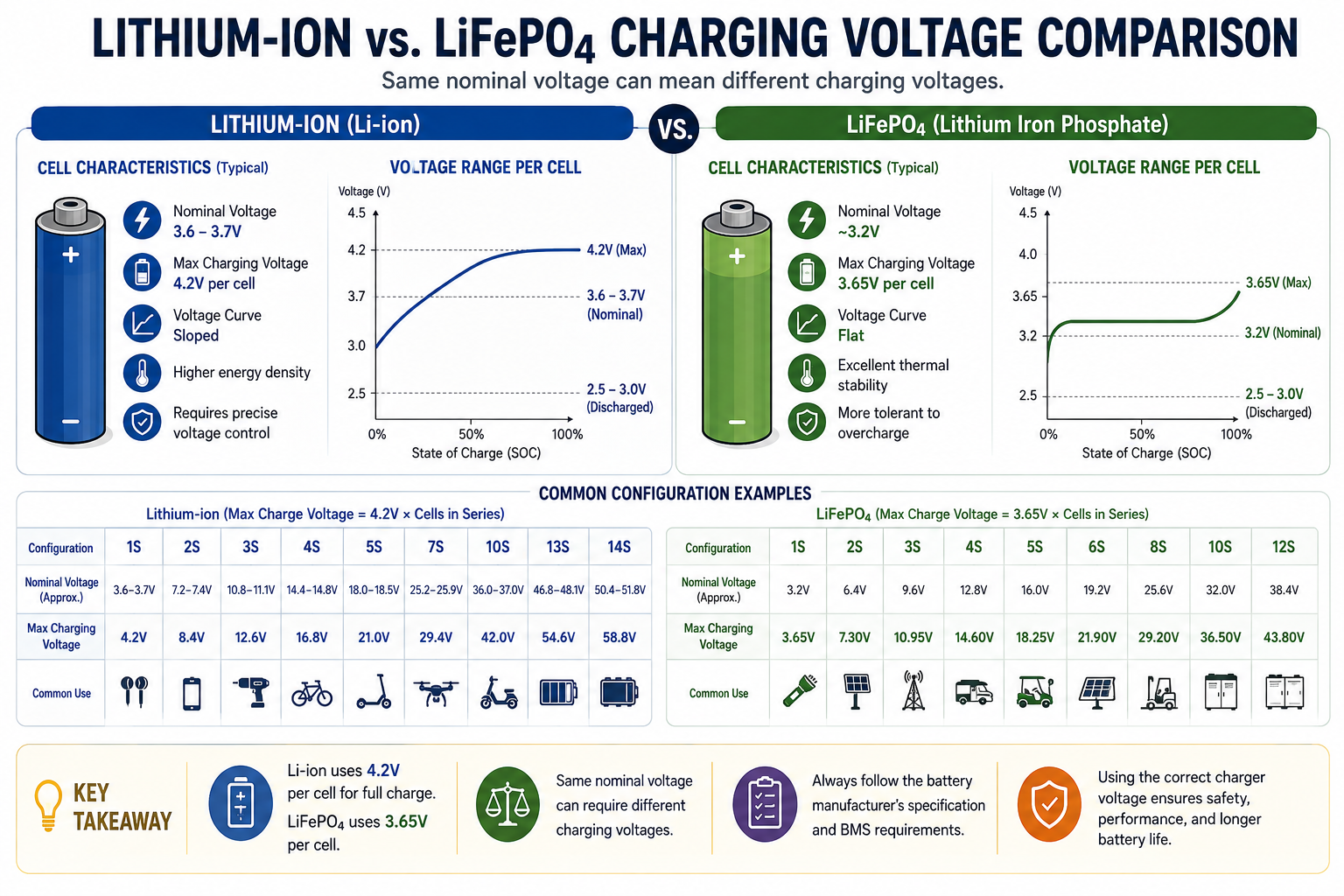
A “12V battery” does not necessarily require a 12V charger.
Always check the specified charging voltage.
Lithium-ion and LiFePO4 batteries have different voltage characteristics.
A charger designed for one chemistry should not automatically be used for another.
A battery pack's charging voltage is strongly related to the number of series cells.
The same nominal voltage label can hide important differences in chemistry and cell configuration.
A charger must be selected based on both voltage and current.
A regulated power adapter is not automatically a battery charger.
Battery charging normally requires appropriate control of voltage and current.
For lithium battery packs, the BMS can play an important role in cell protection, balancing, and battery safety.
However, charger selection should still follow the battery manufacturer's requirements.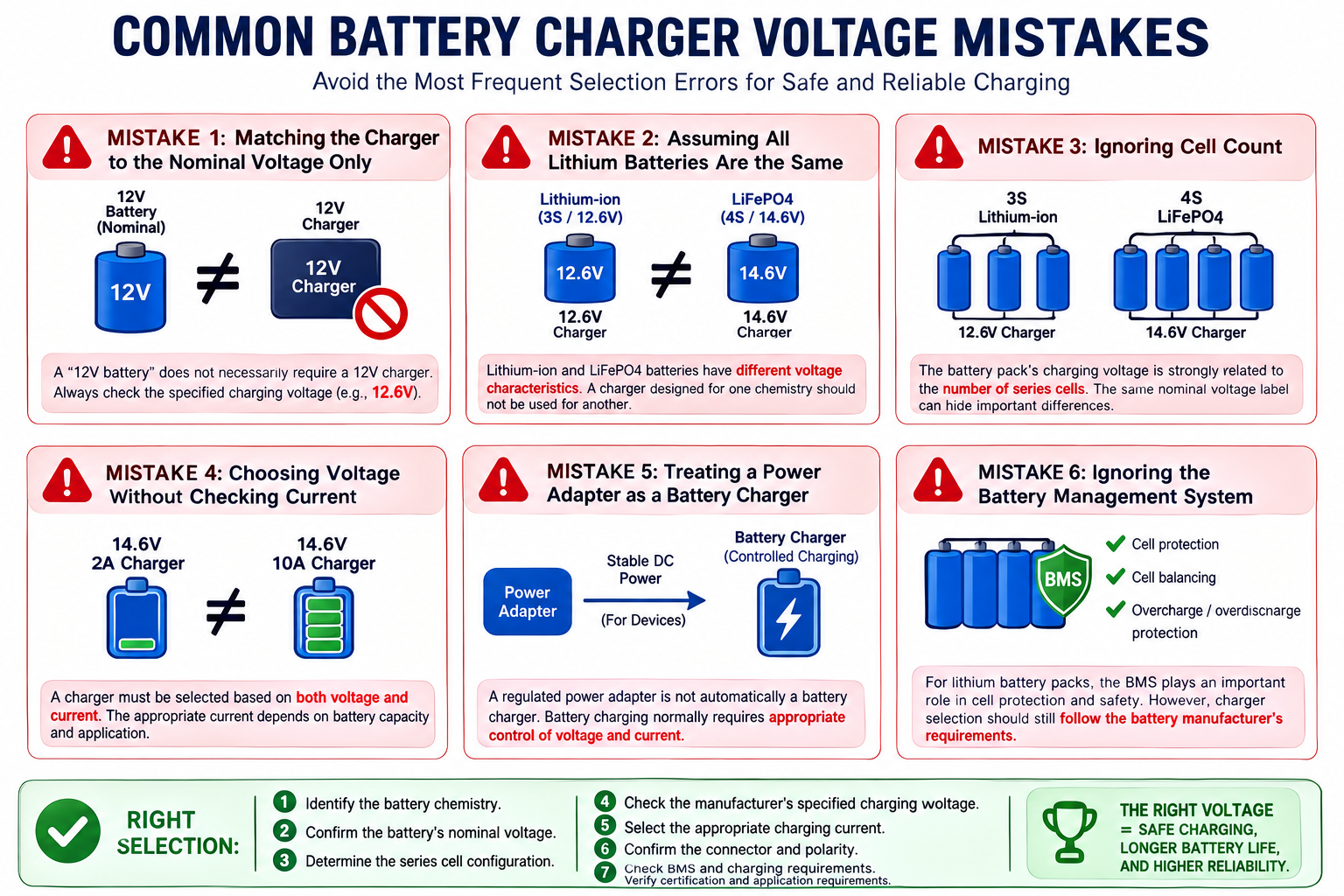
For equipment manufacturers, selecting a battery charger is more complicated than simply choosing a standard voltage.
An OEM battery charger may need to be customized according to:
Battery chemistry
Cell configuration
Charging voltage
Charging current
Charging profile
Connector
Cable length
Enclosure
Cooling requirements
Operating environment
Input voltage
Certification requirements
Communication requirements, where applicable
For example, an equipment manufacturer may need a charger specifically designed for a 14.6V LiFePO4 battery pack with a particular connector and cable configuration.
In another project, the battery system may require a higher-voltage charger such as 42V, 54.6V, or 58.8V.
For these applications, working directly with an experienced charger manufacturer can simplify the process from specification through production.
Guangdong QINX provides AC/DC battery charger solutions for different charging voltages, battery chemistries, output powers, connectors, and application requirements.
For projects requiring engineering or specification adjustments, see Custom Battery Charger.
For manufacturers looking for an OEM supply partner, see OEM Battery Charger.
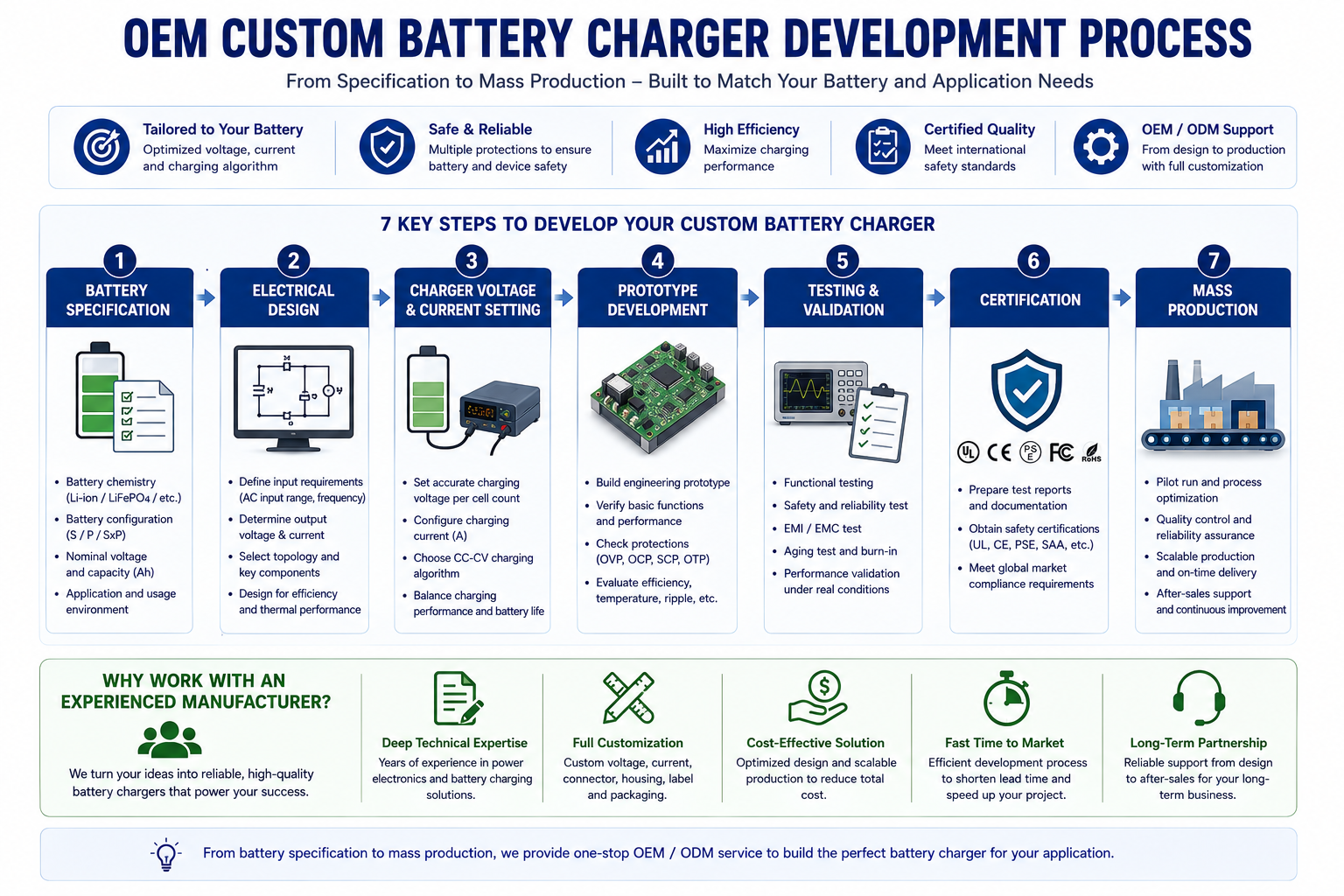
Before placing a charger order, it is worth confirming the complete electrical specification.
A useful checklist includes:
| Specification | What to Confirm |
|---|---|
| Battery chemistry | Li-ion, LiFePO4, lead-acid, etc. |
| Nominal battery voltage | Rated battery voltage |
| Charging voltage | Required maximum/regulated charging voltage |
| Charging current | Required output current |
| Cell configuration | Series and parallel arrangement |
| BMS | Protection and balancing requirements |
| Connector | Plug size, pinout, polarity |
| Input voltage | AC input requirement |
| Certification | Target-market requirements |
| Operating environment | Indoor, outdoor, industrial, etc. |
| Cable | Length and construction |
| Power | Required charging wattage |
For commercial and OEM applications, these specifications should ideally be confirmed before sampling.
Guangdong QINX Technology Co., Ltd. specializes in AC/DC power adapters and battery chargers for a range of commercial and industrial applications.
Its battery charger product structure includes chargers categorized by charging voltage, battery chemistry, form factor, and output power. This makes it possible to evaluate charger requirements based on the actual battery system rather than relying only on a generic “12V” or “24V” label.
Typical charging voltage requirements may include:
12.6V
14.6V
16.8V
21V
25.2V
29.4V
36V
42V
54.6V
58.8V
Other customized charging voltages
Guangdong QINX supports lithium-ion, LiFePO4, lead-acid, and other battery charging applications according to project requirements.
For the complete charger range, visit AC/DC Battery Chargers.
For application-specific requirements, explore Battery Charger for Lithium Battery Packs.
Not necessarily.
A charger described as a “12V battery charger” may have an output voltage higher than 12V, depending on the battery chemistry and charging requirements.
For example, a 3S lithium-ion battery commonly requires a 12.6V charging voltage.
You should not assume that you can.
A 12V lithium battery may require a higher charging voltage, such as 12.6V for a typical 3S lithium-ion configuration or 14.6V for a typical 4S LiFePO4 configuration.
Always follow the battery manufacturer's charging specification.
Not for a typical 3S lithium-ion battery designed for a 12.6V maximum charging voltage.
14.6V is commonly associated with a 4S LiFePO4 charging voltage.
The correct voltage depends on battery chemistry and cell configuration.
It depends on the battery chemistry and series cell configuration.
A common 13S lithium-ion battery pack has a nominal voltage of approximately 48V and a maximum charging voltage of 54.6V.
However, the battery manufacturer's specification should always be checked.
No.
A higher voltage is not a safe way to make a battery charge faster.
The charger must operate within the battery's specified voltage range. Charging speed is also affected by charging current, battery capacity, battery temperature, BMS limits, and the charging profile.
Not automatically.
Even when the batteries have similar nominal voltage ratings, their charging voltage requirements can differ.
A charger must be compatible with the specific battery chemistry and charging specification.
Battery charger voltage is more than a number printed on a charger label.
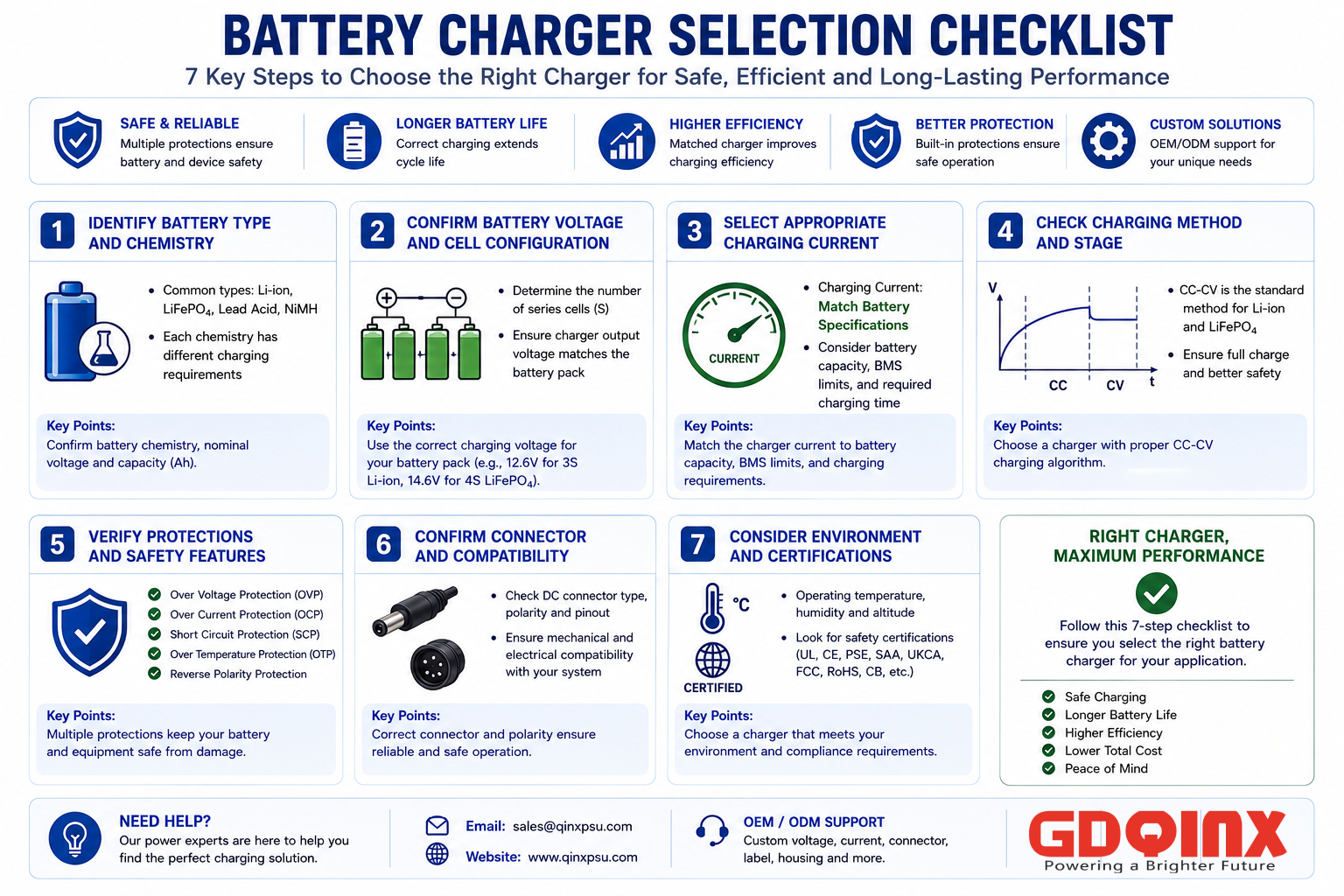
To select the correct charger, you need to understand the relationship between battery chemistry, nominal voltage, cell configuration, maximum charging voltage, charging current, and charging profile.
The most important rule is simple:
Do not choose a battery charger based only on the battery's nominal voltage.
Instead:
Identify the battery chemistry.
Confirm the battery's nominal voltage.
Determine the series cell configuration when applicable.
Check the manufacturer's specified charging voltage.
Select the appropriate charging current.
Confirm the connector and polarity.
Check BMS and charging requirements.
Verify certification and application requirements.
For common lithium-ion configurations, charging voltages such as 12.6V, 16.8V, 29.4V, 42V, 54.6V, and 58.8V are directly related to cell configuration.
For LiFePO4, common charging voltages include 14.6V, 18.25V, 29.2V, 36.5V, 40.15V, and 43.8V, depending on the number of cells in series and the specified charging limit.
When the correct charging voltage is combined with the appropriate charging current, charging algorithm, connector, protection design, and certifications, the result is a much more reliable battery charging solution.
For standard and customized battery charger requirements, Guangdong QINX can support different voltage platforms, battery chemistries, output powers, connectors, and OEM requirements.
Explore AC/DC Battery Chargers or learn more about Custom Battery Charger for project-specific requirements.


