
Battery charging is more than simply connecting a charger to a battery and waiting until it reaches full capacity. Modern battery chargers use carefully controlled charging stages to improve charging efficiency, extend battery lifespan, and maintain safety. To better understand the basic role and working principle of charging devices, you can first read our guide: What Is a Battery Charger?
Understanding battery charging stages is essential for engineers, product designers, distributors, and users who need reliable charging solutions for lithium-ion batteries, LiFePO4 batteries, lead-acid batteries, and other rechargeable battery systems.
A properly designed charging process controls key parameters such as voltage, current, temperature, and charging time. Different battery chemistries require different charging strategies, and using an unsuitable charger may lead to reduced battery performance, overheating, shortened cycle life, or even safety risks.
The most common charging method used in modern battery systems is the CC/CV charging method (Constant Current / Constant Voltage). This method is widely applied in lithium battery chargers, including chargers for portable devices, electric mobility products, industrial equipment, energy storage systems, and custom OEM applications.
As a professional power supply and battery charger manufacturer, Guangdong QINX Technology Co.,LTD. develops AC/DC power adapters and battery charging solutions designed for different battery types and application requirements. By combining stable power conversion technology with precise charging control, Guangdong QINX helps customers achieve safer and more efficient battery charging performance.
This article explains the complete battery charging process, including:

Battery charging stages are the different phases a rechargeable battery goes through during the charging process. Each stage has a specific purpose, such as increasing battery capacity quickly, controlling voltage, balancing cells, or maintaining long-term battery health.
A battery does not charge at the same speed from 0% to 100%. Instead, the charger automatically adjusts output voltage and current according to the battery’s condition.
A typical smart charging process includes several stages:
For lithium batteries, especially lithium-ion and LiFePO4 batteries, the charging process is usually based on the CC/CV method.
The reason is simple:
A professional battery charger continuously monitors battery conditions and adjusts charging parameters automatically.
For example, a 12.8V LiFePO4 battery pack requires a charger with a suitable charging voltage, typically around 14.6V for a 4-cell LiFePO4 battery system. Using an incorrect charger may prevent the battery from reaching full capacity or may affect battery reliability.
The charging stage management directly affects:
Overcharging, excessive current, or uncontrolled voltage can accelerate battery degradation.
A properly designed charger prevents:
A multi-stage charging process allows the battery to receive maximum energy during the early charging phase while slowing down safely near full capacity.
This improves:
Smart charging systems integrate multiple protections, including:
These protections are especially important for lithium battery applications where charging accuracy is critical.
Different battery chemistries require different charging methods. Before understanding charging stages, it is important to understand the relationship between battery type and charging strategy.
Lithium-ion batteries are commonly used in:
Lithium-ion batteries typically use the CC/CV charging method.
The charger first supplies constant current to quickly increase battery capacity. When the battery voltage reaches the preset limit, the charger switches to constant voltage mode and gradually reduces charging current.
Lithium Iron Phosphate (LiFePO4) batteries have become increasingly popular because of:
However, LiFePO4 batteries have different charging requirements compared with traditional lithium-ion batteries.
For example:
Using a charger designed specifically for LiFePO4 chemistry helps ensure proper charging performance.
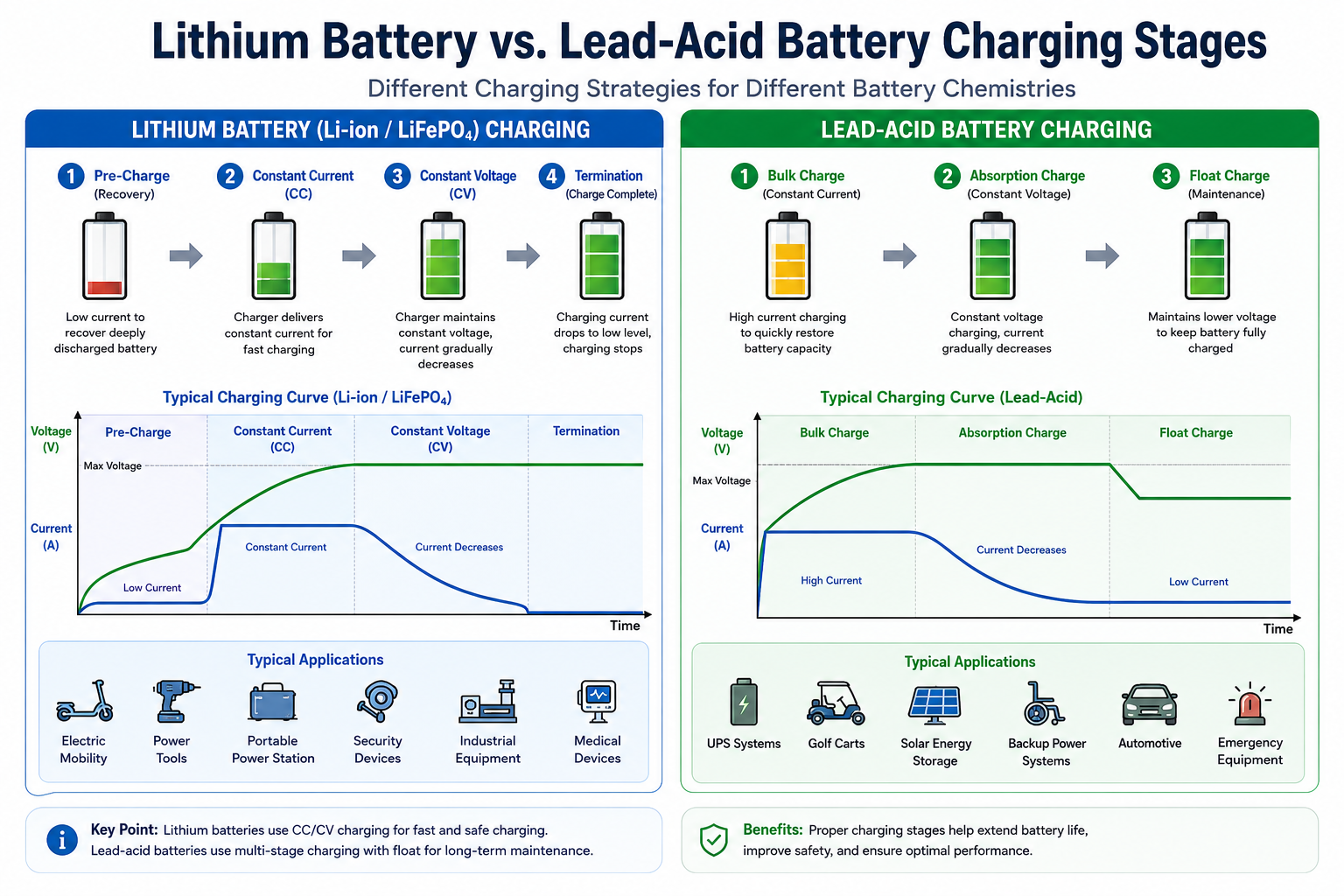
Traditional lead-acid batteries commonly use multi-stage charging, including:
Unlike lithium batteries, lead-acid batteries often remain connected to chargers for long periods, so float charging is widely used to maintain battery voltage.
Applications include:
The majority of modern lithium battery chargers use CC/CV charging technology.
CC/CV means:
This charging method balances charging speed and battery protection.
During the charging process:
The charger provides a fixed charging current while battery voltage gradually increases.
Example:
This stage is responsible for most of the charging process.
When the battery reaches its maximum charging voltage, the charger changes from constant current mode to constant voltage mode.
At this stage:
When the current drops below a preset level, the battery is considered fully charged.
The CC/CV charging method is one of the most important charging technologies used in modern lithium battery systems. For a more detailed explanation of how Constant Current and Constant Voltage charging work, please read our guide: CC CV Charging Explained.
Although different battery chemistries may use different charging algorithms, most modern smart chargers follow a structured multi-stage charging process.
The charging stages determine how quickly energy is delivered, how safely the battery reaches full capacity, and how effectively battery life is maintained.
A typical lithium battery charging process consists of four main stages:
Some battery systems, especially lead-acid batteries, may also include a fifth stage:
The pre-charging stage is the initial phase when a battery voltage is extremely low or has been deeply discharged.
During this stage, the charger supplies a small current to safely recover the battery before normal charging begins.
This stage is particularly important for lithium batteries because deeply discharged lithium cells may require careful current control.
The main purposes of pre-charging include:
For example, if a lithium battery voltage drops below the safe operating range, applying full charging current immediately may create unnecessary stress on the battery cells.
A smart battery charger can detect abnormal battery conditions and automatically start a low-current recovery process.
For a lithium battery pack:
This process improves safety and helps extend battery cycle life.

The Constant Current (CC) stage is the fastest charging phase and usually provides the majority of the battery charging capacity.
During CC charging:
This stage is designed to maximize charging efficiency while keeping the charging current within safe limits.
For example:
A 12.8V LiFePO4 battery charger rated at 14.6V 10A will typically provide approximately 10A constant current during the early charging period.
The actual charging current depends on:
The CC stage provides several advantages:
Most of the battery energy is added during this stage.
For applications requiring quick turnaround, such as:
a properly designed CC charging stage significantly reduces charging time.
By limiting current, the charger prevents:
A controlled current prevents the battery from receiving more energy than it can safely accept.
After the battery voltage reaches the preset charging limit, the charger switches to Constant Voltage (CV) mode.
This is the second major stage of lithium battery charging.
During CV charging:
For lithium batteries, voltage accuracy is extremely important.
For example:
A 4-cell LiFePO4 battery pack:
When the battery reaches 14.6V, the charger maintains this voltage while reducing current gradually.
As the battery becomes full, its internal resistance increases.
The battery naturally accepts less current, so the charger reduces current output.
This prevents:
The CV stage is slower than the CC stage, but it is essential for achieving maximum battery capacity safely.
The charging termination stage occurs when the battery reaches full charge.
At this point:
Different battery systems use different termination methods.
Common methods include:
The charger stops charging when current decreases below a preset value.
Example:
A charger may consider the battery fully charged when charging current drops below 10% of rated current.
Some chargers use maximum charging time limits as additional protection.
This prevents continuous charging if abnormal conditions occur.
Advanced battery systems may communicate directly with chargers through:
This allows more precise charging control.
Float charging is commonly used for lead-acid batteries but is less common for lithium batteries.
The purpose of float charging is maintaining battery voltage after reaching full charge.
Typical applications include:
During float charging:
Generally, lithium batteries do not require continuous float charging.
Keeping lithium batteries at maximum voltage for long periods may accelerate aging.
For lithium-ion and LiFePO4 batteries, smart chargers usually:
The correct charging strategy depends on battery chemistry and application requirements.
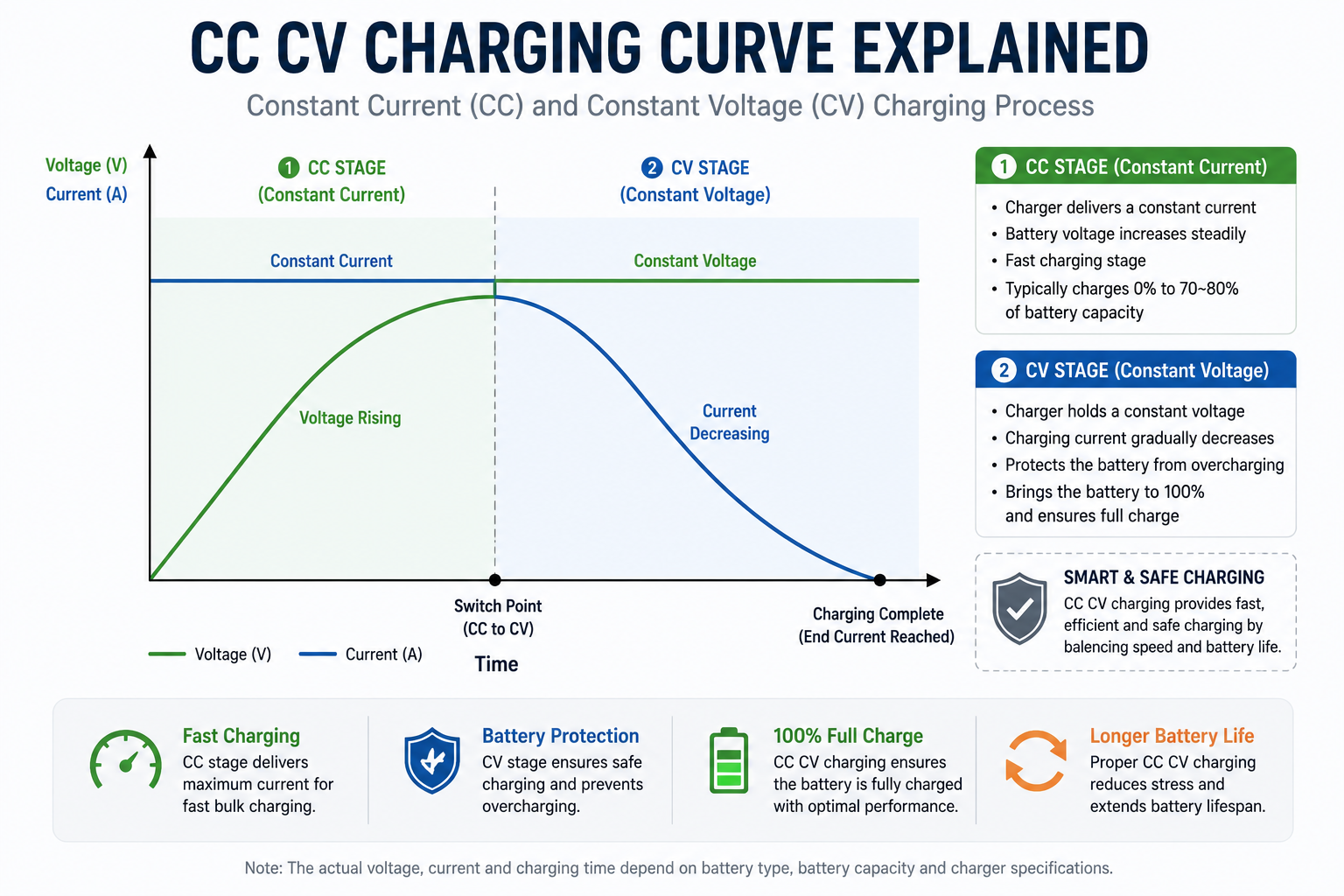
A charging curve shows how voltage and current change during different charging stages.
For lithium batteries, the charging curve typically contains two major sections:
Characteristics:
This region usually charges the battery from approximately 0% to 70–90% capacity.
Characteristics:
This stage completes the remaining capacity while protecting battery health.
Different batteries require different charging strategies.
Using the wrong charger can negatively affect performance and safety.
Lithium-ion batteries normally use:
Advantages:
Applications:
LiFePO4 batteries also use CC/CV charging but require different voltage settings.
Typical examples:
| Battery Type | Charging Voltage |
|---|---|
| 12V LiFePO4 | 14.6V |
| 24V LiFePO4 | 29.2V |
| 48V LiFePO4 | 58.4V |
Advantages:
Because LiFePO4 batteries have different voltage characteristics, using a dedicated LiFePO4 charger is recommended.
Since LiFePO4 and lithium-ion batteries have different charging voltage requirements and charging characteristics, choosing the correct charger is critical. Learn more about the differences between these two charging solutions in our guide: LiFePO4 Charger vs Lithium-Ion Charger.
Lead-acid batteries usually follow:
These stages are different from lithium battery charging.
Applications include:
Modern battery chargers are no longer simple AC-to-DC power conversion devices. A smart battery charger combines power conversion technology, charging algorithms, and protection systems to automatically manage different charging stages. For a complete overview of lithium battery charging principles, charger selection, and common applications, please read our guide: Lithium Battery Charger Guide.
The charger continuously monitors battery conditions and adjusts output parameters according to the battery status.
A smart charging system typically monitors:
Based on this information, the charger determines when to switch between charging stages.
For example:
This automatic process improves charging safety and reduces the risk of battery damage.
A smart charger provides high charging current when the battery can safely accept it and reduces current when the battery approaches full capacity.
This achieves a balance between:
Incorrect charging is one of the major factors affecting battery aging.
Smart charging helps prevent:
By controlling charging stages accurately, batteries can maintain better performance over more charging cycles.
Professional battery chargers usually integrate multiple protection features, including:
For lithium battery applications, these protections are especially important because lithium cells require precise voltage control.
Selecting the correct charger requires more than matching the connector size. The charger must match the battery chemistry, voltage, capacity, and required charging method.
The following factors should be considered.
Different batteries require different charging algorithms.
Examples:
| Battery Type | Recommended Charging Method |
|---|---|
| Lithium-ion | CC/CV charging |
| LiFePO4 | Dedicated CC/CV charging |
| Lead-acid | Multi-stage charging with float |
| NiMH | Different charging control methods |
Using an incompatible charger may cause:
The charger output voltage must match the battery system.
Examples:
For lithium batteries:
A battery pack voltage determines the required charger voltage.
Examples:
4S LiFePO4 battery:
8S LiFePO4 battery:
Charging current affects both charging speed and battery health.
A higher current charger can reduce charging time but may increase heat generation.
The appropriate charging current depends on:
For example:
A 100Ah LiFePO4 battery:
The charging environment also affects charger selection.
Industrial applications may require:
Outdoor applications may require:
Medical or professional equipment may require:

Many charging problems are caused by selecting an unsuitable charger.
The following mistakes should be avoided.
A lithium-ion charger and a LiFePO4 charger are not always interchangeable.
Although both use CC/CV charging, their voltage settings are different.
Example:
A 14.6V LiFePO4 charger should not be used for a lithium-ion battery system requiring a different charging voltage.
Voltage is important, but it is not the only factor.
A complete charger selection should consider:
For commercial products, safety certifications are critical.
Depending on the target market, customers may require:
Working with a manufacturer experienced in international certification can reduce product development risks.
Choosing the right battery charger supplier is important for companies developing their own products.
Choosing the right battery charger supplier is important for companies developing their own products. For businesses looking for customized charging solutions, Guangdong QINX provides OEM Battery Charger Solutions including customized voltage, current, connectors, cable lengths, housing designs, and certification support.
With experience in different charging applications, Guangdong QINX provides:
Customers can customize:
Guangdong QINX supports charging solutions for:
Typical applications include:
As a professional charger manufacturer, Guangdong QINX focuses on:
The company provides power solutions ranging from compact adapters to higher-power charging products for different application requirements.
When selecting a battery charger supplier, customers usually consider:
Guangdong QINX works with customers to evaluate:
For customers with specific product requirements, Guangdong QINX provides customized development support from prototype evaluation to mass production.
Every charging solution is designed with attention to:
The main battery charging stages include:
Some battery types, such as lead-acid batteries, may also include float charging.
CC charging maintains a constant charging current while battery voltage increases.
CV charging maintains a constant voltage while charging current gradually decreases.
Together, CC and CV provide fast and safe charging for lithium batteries.
The charging time depends on:
Usually, the CC stage completes most charging, while the CV stage takes longer to complete the final capacity.
Generally, no.
Different battery chemistries require different charging parameters.
A charger designed for LiFePO4 batteries may not be suitable for lithium-ion or lead-acid batteries.
Charging slows down because the charger enters Constant Voltage mode.
The charger maintains the maximum voltage limit while reducing current to protect the battery.
Battery charging stages play a critical role in charging speed, safety, and battery lifespan.
From pre-charging and Constant Current charging to Constant Voltage charging and final charge management, each stage has a specific purpose.
For lithium-ion and LiFePO4 batteries, the CC/CV charging method has become the industry standard because it provides an effective balance between fast charging and battery protection.
Selecting the right charger requires careful consideration of:
As an experienced battery charger manufacturer, Guangdong QINX Technology Co.,LTD. provides reliable AC/DC power adapters and customized battery charging solutions for customers worldwide.
With professional engineering support, flexible customization capability, and a focus on stable charging performance, Guangdong QINX helps businesses develop safer and more efficient battery-powered products.


