
UKCA certification is a term commonly used to describe compliance with UK product regulations and the use of the UKCA marking on products placed on the Great Britain market.
UKCA stands for UK Conformity Assessed. It is the conformity marking used for certain goods placed on the Great Britain market, covering England, Scotland, and Wales. It was introduced following the UK's departure from the European Union and was originally intended to replace the CE marking for many products in Great Britain.
However, the regulatory situation is more flexible than the original UKCA transition plans suggested. For many product categories, the UK government now allows continued recognition of CE marking in Great Britain, meaning manufacturers may be able to use either CE or UKCA depending on the applicable regulations and product requirements.
For manufacturers, importers, distributors, engineers, and purchasing teams, understanding this distinction is important.
A product does not become compliant simply because a UKCA logo is printed on its label. The manufacturer must identify the applicable UK legislation, meet the relevant essential requirements, complete the appropriate conformity assessment procedure, prepare technical documentation, issue the relevant Declaration of Conformity, and apply the correct marking.
This is particularly important for electrical products such as AC/DC power adapters, battery chargers, and other power conversion equipment.
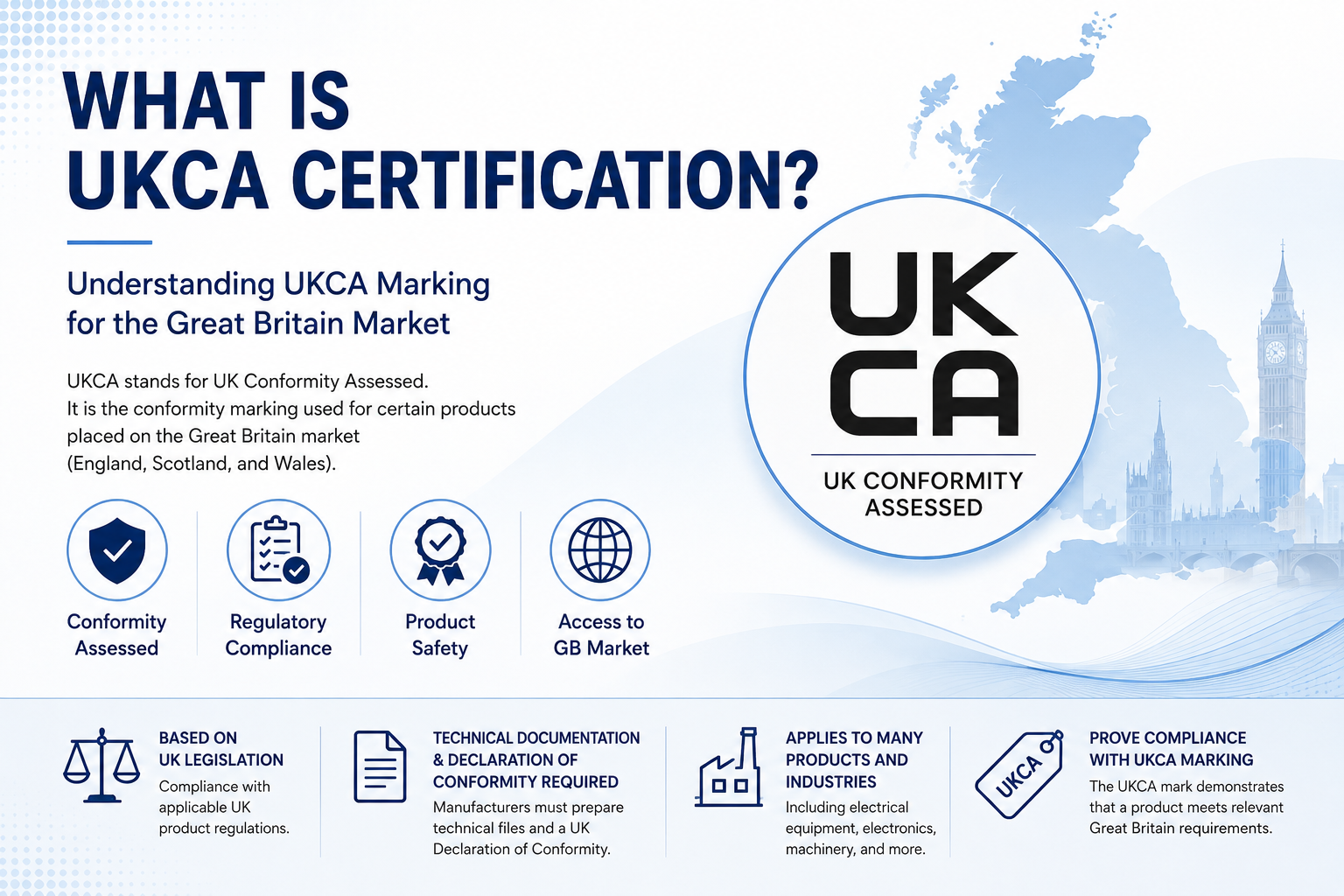
UKCA stands for UK Conformity Assessed.
The UKCA marking demonstrates that a product has been assessed against applicable Great Britain product regulations and meets the relevant requirements for being placed on the GB market.
The term "UKCA certification" is widely used in commercial and technical discussions, but it is important to understand the terminology.
UKCA is primarily a conformity marking, not a universal certificate issued by one single UKCA certification authority.
Depending on the product and applicable legislation, conformity assessment may involve:
Manufacturer self-declaration
Testing against applicable standards
Technical documentation
Internal production controls
Third-party conformity assessment
An Approved Body where required
A UK Declaration of Conformity
UKCA marking
The exact route depends on the product category and the regulations that apply.
For this reason, manufacturers should not assume that every product requires a UKCA certificate from a third-party laboratory.
Some products can be assessed through a manufacturer's own conformity assessment process, while others require third-party assessment under the relevant legislation.
The first step is therefore always to identify the applicable product regulations.
For electrical and electronic equipment, manufacturers may need to consider several regulatory frameworks rather than treating UKCA as a single standalone certification program.
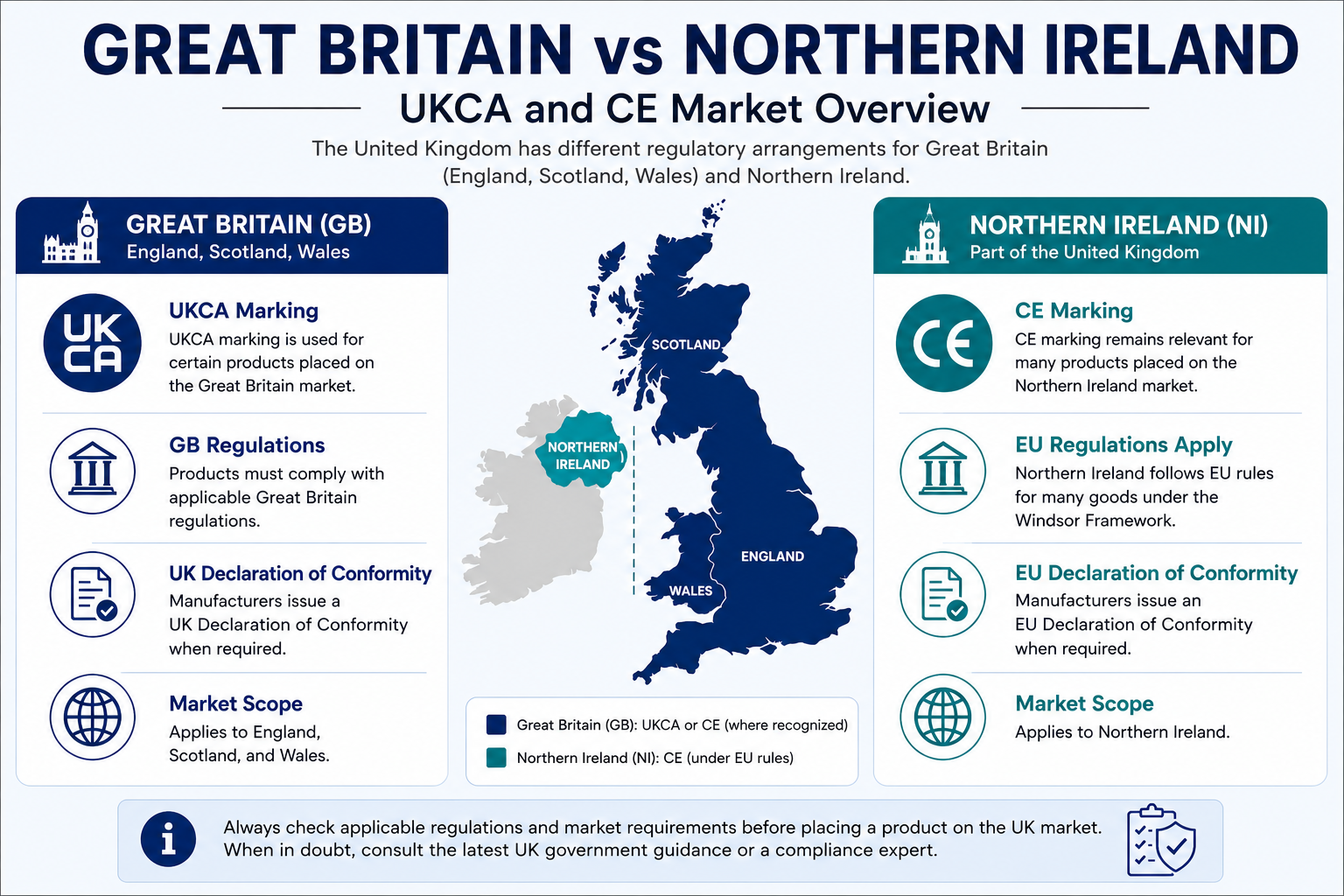
UKCA applies primarily to products placed on the Great Britain market.
Great Britain consists of:
England
Scotland
Wales
Northern Ireland follows a different regulatory framework because of the Northern Ireland Protocol/Windsor Framework arrangements.
This distinction is critical for companies selling products throughout the United Kingdom.
A manufacturer exporting a power adapter to Manchester, London, Glasgow, or Cardiff is dealing with the Great Britain market.
A manufacturer exporting the same product to Belfast needs to consider the applicable Northern Ireland requirements separately.
For many products, CE marking remains relevant for Northern Ireland and the EU.
The UK government provides separate guidance for Great Britain and Northern Ireland because the conformity assessment and marking routes are not identical.
This is one of the most important questions for manufacturers.
The short answer is:
Not necessarily.
The original UKCA transition plan was designed around replacing CE marking with UKCA marking for many products sold in Great Britain.
However, UK legislation has subsequently introduced continued recognition of CE marking for many product sectors.
For many electrical products, manufacturers can therefore choose between CE and UKCA when placing compliant products on the Great Britain market, provided the relevant conditions are satisfied.
The Electrical Equipment (Safety) Regulations 2016 guidance states that businesses can use either CE or UKCA markings for covered electrical equipment placed on the Great Britain market, subject to meeting the applicable requirements.
This means that a company should not automatically assume:
"UKCA is mandatory because the product is being sold in the UK."
Instead, the correct question is:
Which conformity assessment and marking regime applies to this specific product, market, and regulatory framework?
The answer can depend on:
Product category
Applicable UK regulations
Applicable EU requirements
Destination market
Conformity assessment route
Whether third-party assessment is mandatory
Whether the product falls under a sector-specific regime
The UK government updated its UKCA and CE guidance in March 2026 to clarify continued recognition of CE marking and the relationship between UK and EU requirements.
For B2B purchasing teams, this is an important point to discuss with suppliers before requesting a specific marking.
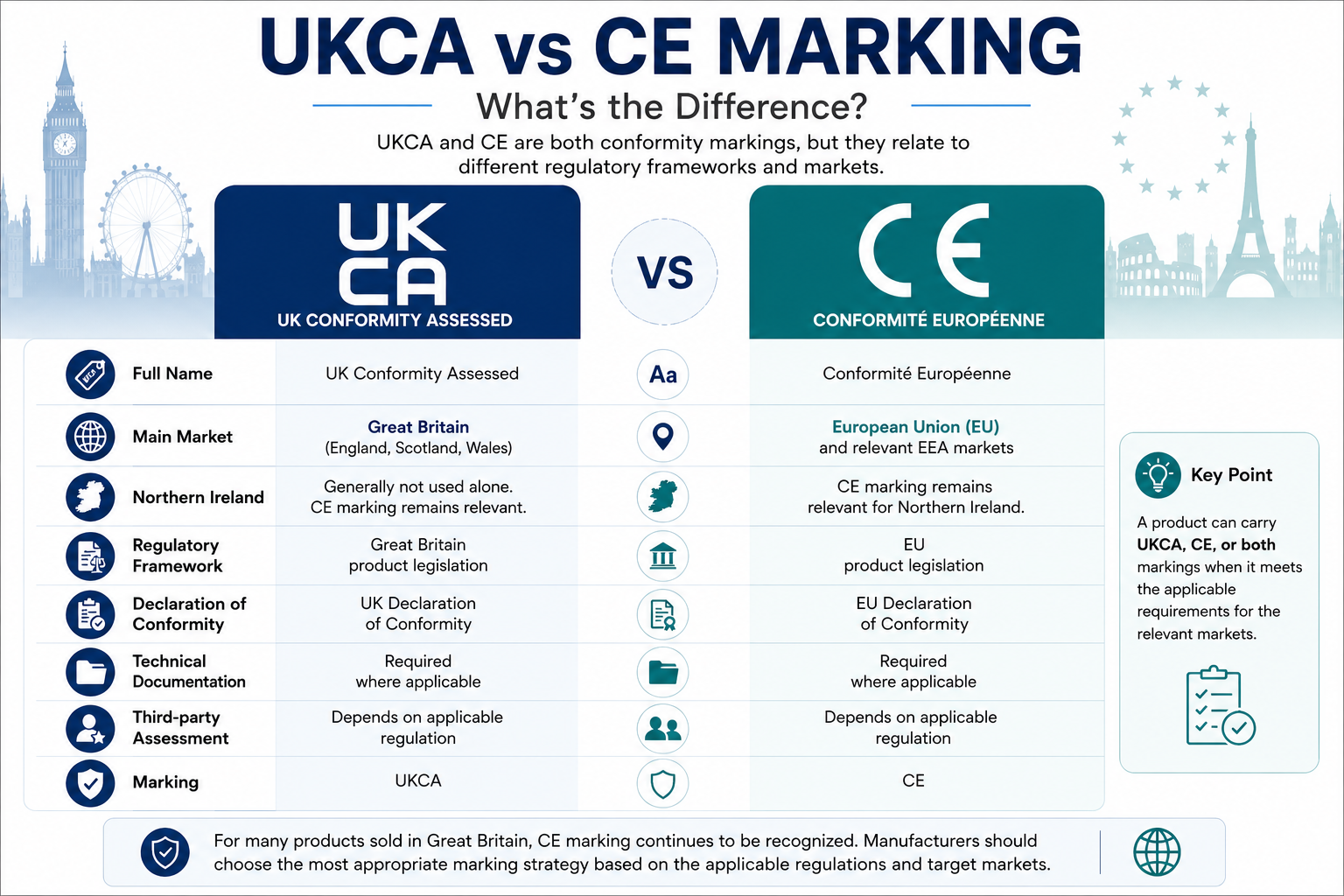
UKCA and CE are both conformity markings, but they relate to different regulatory frameworks.
CE marking is associated primarily with European Union product legislation.
UKCA marking is associated with applicable Great Britain product regulations.
The key difference is therefore not simply the logo itself.
The underlying compliance framework, applicable legislation, standards, conformity assessment route, technical documentation, and Declaration of Conformity must all be considered.
| Feature | UKCA | CE |
|---|---|---|
| Full name | UK Conformity Assessed | Conformité Européenne |
| Main market | Great Britain | European Union and relevant EEA markets |
| Northern Ireland | Generally not used alone | CE remains relevant |
| Regulatory framework | Great Britain legislation | EU legislation |
| Technical documentation | Required where applicable | Required where applicable |
| Declaration of Conformity | UK Declaration of Conformity | EU Declaration of Conformity |
| Third-party assessment | Depends on applicable regulation | Depends on applicable regulation |
| Marking | UKCA | CE |
For many electrical products sold in Great Britain, CE marking continues to be recognized under current UK arrangements. Therefore, choosing UKCA versus CE should be based on the product's regulatory strategy rather than simply assuming that one mark is always mandatory.
Yes, power adapters can fall under UK product regulations.
AC/DC power adapters are electrical products that convert mains AC power into regulated DC power for electronic equipment.
Depending on their design and intended use, relevant regulatory considerations may include:
Electrical safety
Electromagnetic compatibility
Restriction of hazardous substances
Energy efficiency requirements
Product labeling
Technical documentation
Conformity assessment
Declaration of Conformity
For electrical equipment, the Electrical Equipment (Safety) Regulations 2016 apply to equipment designed or adapted for use within specified voltage ranges, including equipment operating between 50 and 1,000 V AC or 75 and 1,500 V DC.
This does not mean that every power adapter has exactly the same compliance requirements.
The manufacturer must evaluate the specific product.
For example, a desktop AC/DC adapter may have:
100–240 VAC input
12 V DC output
24 V DC output
19 V DC output
90 W output
120 W output
IEC inlet
DC barrel connector
Fixed DC cable
The exact electrical design and intended application determine the applicable compliance requirements.
Manufacturers should therefore evaluate compliance at the product level rather than relying only on a generic "UKCA-ready" statement.
For customers looking for standard power conversion products, AC/DC Power Adapters can be evaluated according to their required input range, output voltage, output current, power rating, connector, application, and target market.
Battery chargers can also fall within the scope of UK product regulations.
However, battery chargers have additional technical considerations because their output is intended to charge a battery rather than simply provide power to an electronic load.
A battery charger may need to consider:
Battery chemistry
Battery voltage
Maximum charging voltage
Charging current
CC/CV charging profile
Protection functions
Battery Management System compatibility
Temperature conditions
Electromagnetic compatibility
Electrical safety
Applicable environmental requirements
For example, a charger designed for a lithium-ion battery pack may use a specific CC/CV charging profile, while a LiFePO4 battery requires a different charging voltage.
The regulatory assessment does not replace technical battery compatibility.
A charger can be compliant with applicable regulations and still be unsuitable for a particular battery system if its electrical specifications do not match the battery manufacturer's requirements.
For companies developing battery-powered equipment, Battery Chargers should therefore be evaluated from both a regulatory and engineering perspective.
UKCA compliance is not a single test.
Electrical products may be subject to several regulations depending on their characteristics.
The Electrical Equipment (Safety) Regulations 2016 establish safety requirements for electrical equipment placed on the Great Britain market.
Manufacturers must ensure that applicable equipment is designed and manufactured according to the relevant safety objectives and must complete the required conformity assessment and documentation process.
For power adapters, important technical areas may include:
Insulation
Creepage and clearance
Dielectric strength
Leakage current
Protection against electric shock
Temperature rise
Abnormal operation
Mechanical safety
Fire-related considerations
The precise testing requirements depend on the product design and applicable standards.
Electrical and electronic equipment may also need to comply with the Electromagnetic Compatibility Regulations 2016.
The purpose is to control electromagnetic emissions and ensure that equipment has sufficient immunity to expected electromagnetic disturbances.
For power adapters and battery chargers, EMC evaluation can involve areas such as:
Conducted emissions
Radiated emissions
Electrostatic discharge
Electrical fast transients
Surge
Radio-frequency immunity
Voltage dips and interruptions
A power supply that meets electrical safety requirements but produces excessive electromagnetic interference may still fail the applicable EMC requirements.
Electrical and electronic equipment may also be subject to the Restriction of the Use of Certain Hazardous Substances in Electrical and Electronic Equipment Regulations 2012.
The GB RoHS framework restricts specified hazardous substances in applicable electrical and electronic equipment.
Compliance can involve:
Material declarations
Supplier documentation
Component control
Bill-of-material review
Laboratory analysis where necessary
Technical records
For manufacturers operating international supply chains, controlling component and material information is therefore an important part of compliance management.
Some external power supplies and energy-related products may also be subject to applicable energy efficiency or ecodesign requirements.
The applicable requirements depend on the specific product category and current legislation.
This is particularly relevant for manufacturers of external power supplies because energy efficiency requirements can affect:
No-load power consumption
Average active efficiency
Operating modes
Product labeling
Technical documentation
Therefore, UKCA planning should not be reduced to one logo or one laboratory report.
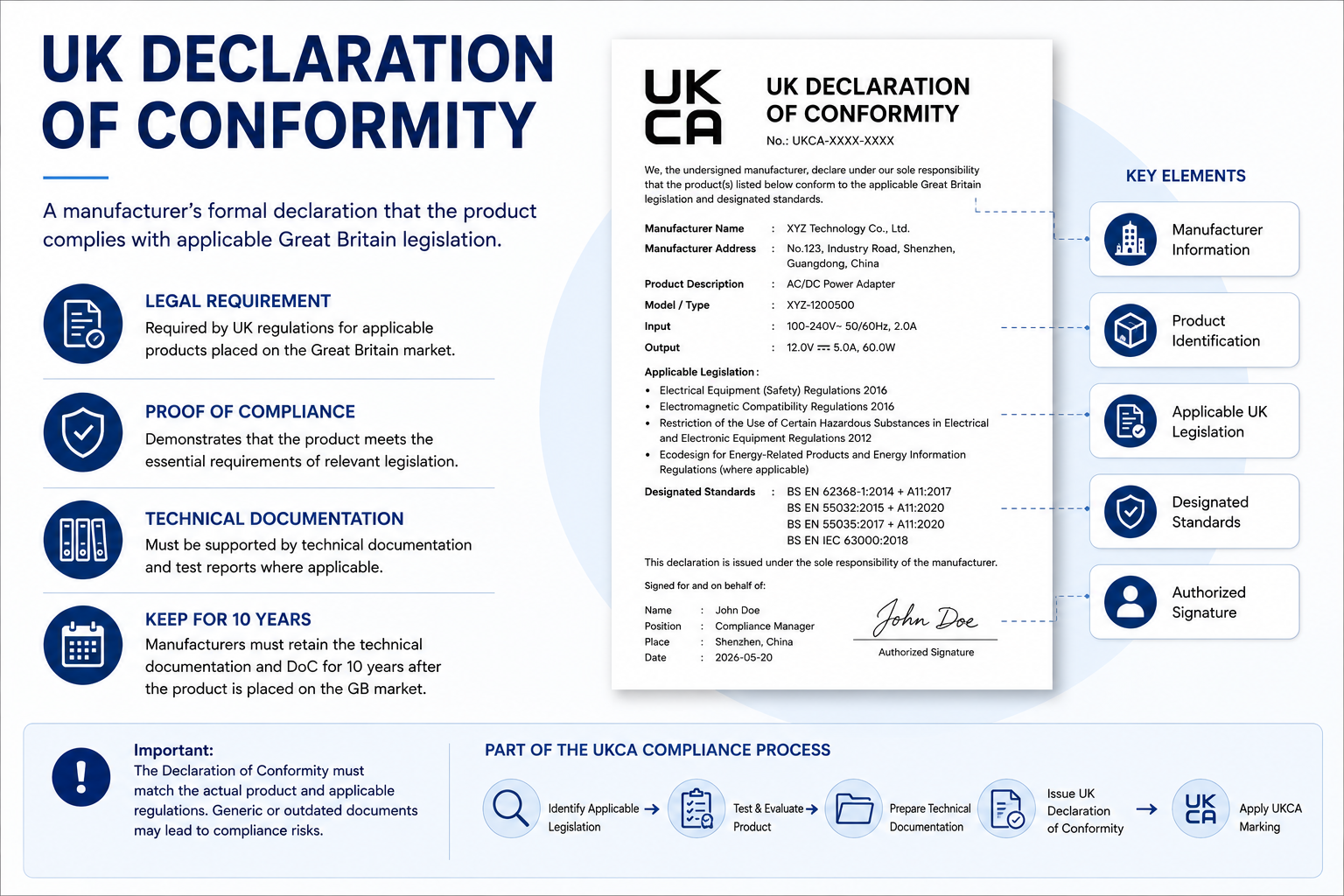
A UK Declaration of Conformity, often abbreviated as UK DoC, is a formal document in which the manufacturer declares that the product complies with the applicable Great Britain legislation.
The exact content depends on the regulations that apply.
A Declaration of Conformity may identify:
Product name
Product model
Manufacturer
Manufacturer address
Applicable legislation
Relevant standards
Conformity assessment procedure
Identification of the responsible party
Signature
Date
Authorized representative information where applicable
The declaration should correspond to the actual product being placed on the market.
For example, if a manufacturer has several power adapter models with different electrical designs, the supporting documentation should clearly identify the applicable models and compliance basis.
A generic declaration copied from another product is not an appropriate substitute for product-specific conformity documentation.
Manufacturers should also maintain their technical documentation and supporting evidence for the required retention period.
For electrical equipment covered by the Electrical Equipment (Safety) Regulations, manufacturers are required to retain technical documentation and the relevant Declaration of Conformity for 10 years after the equipment has been placed on the GB market.
Technical documentation is one of the most important parts of conformity assessment.
The exact documentation package depends on the product and applicable regulations, but it can include:
Documents may include:
Product model
Electrical ratings
Input voltage
Output voltage
Output current
Rated power
Operating temperature
Connector specifications
Mechanical drawings
Depending on the conformity assessment requirements, technical files may contain:
Circuit diagrams
PCB information
Critical component information
Safety-related component specifications
Transformer specifications
Protection circuit information
Manufacturers may need to identify foreseeable risks associated with the product and demonstrate how those risks are controlled.
Supporting test reports may cover:
Electrical safety
EMC
Environmental requirements
Energy efficiency
RoHS-related compliance
The manufacturer should identify the standards used to demonstrate conformity where applicable.
For Great Britain, designated standards can provide a presumption of conformity with corresponding essential requirements, although manufacturers remain responsible for ensuring that the applicable legal requirements are met.
The final technical documentation package should support the relevant Declaration of Conformity.
A strong compliance system therefore connects:
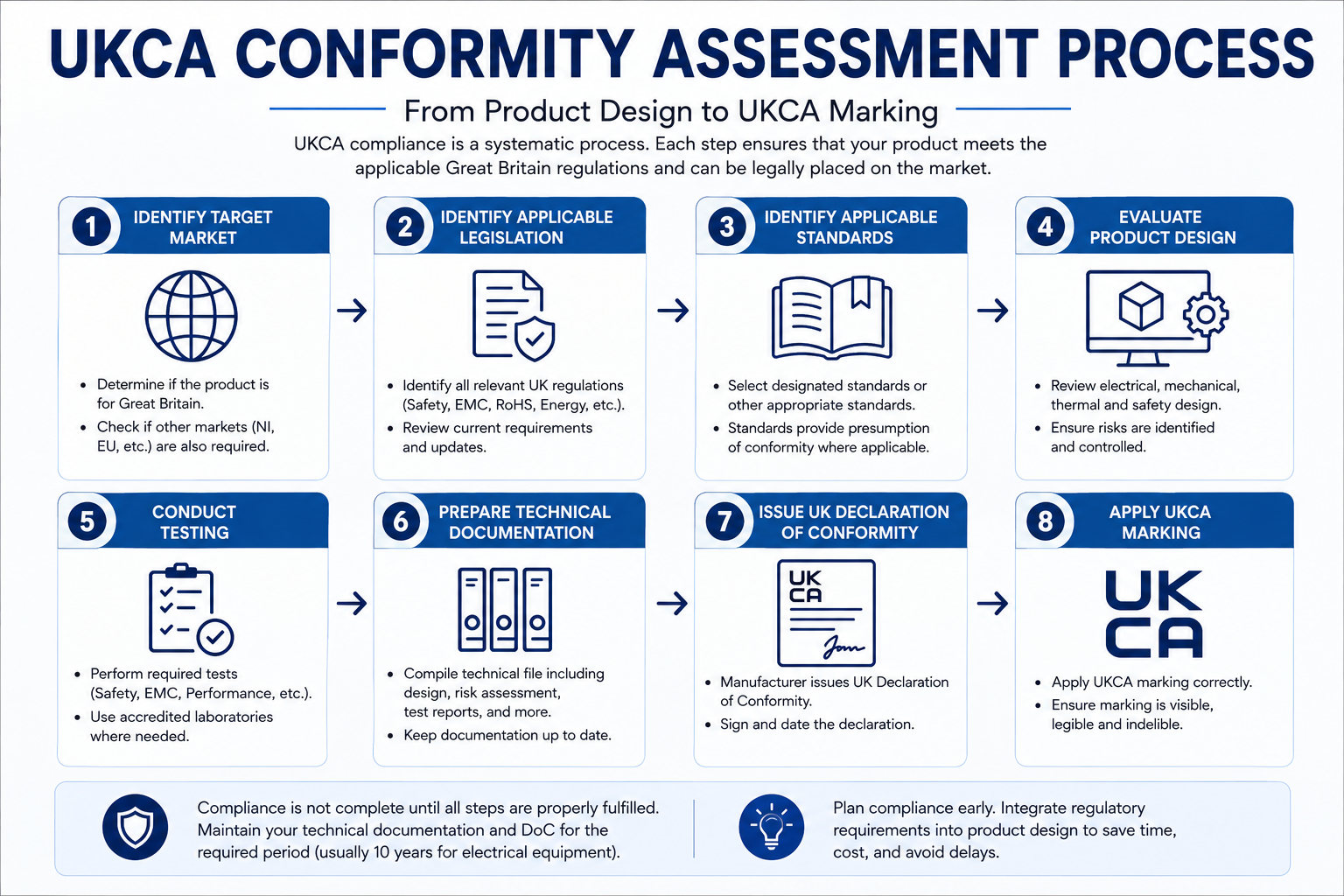
Product design → Applicable regulations → Standards → Testing → Technical documentation → Declaration of Conformity → Marking
The process can vary depending on the product category.
For a typical electrical product, manufacturers can use a structured workflow.
First determine whether the product is intended for:
Great Britain
Northern Ireland
European Union
Multiple markets
This determines which regulatory frameworks need to be considered.
Determine which UK regulations apply to the product.
For an AC/DC power adapter, this may include electrical safety, EMC, RoHS, and applicable energy efficiency requirements.
Manufacturers should identify appropriate designated standards or other applicable standards used to demonstrate conformity.
Engineering teams review:
Circuit design
PCB layout
Transformer design
Insulation system
Protection circuits
Enclosure
Connectors
Cable construction
Thermal performance
Testing is performed according to the applicable requirements.
The manufacturer compiles the evidence supporting conformity.
The manufacturer prepares the relevant declaration.
Where UKCA is the selected and applicable route, the UKCA marking is applied according to the relevant marking rules.
This process demonstrates why UKCA should be considered a compliance system rather than simply a certification logo.
Not always.
Whether third-party conformity assessment is required depends on the specific legislation and conformity assessment procedure applicable to the product.
Some products can use manufacturer self-declaration.
Other products require involvement from an Approved Body.
This distinction is important because customers sometimes ask suppliers:
"Do you have a UKCA certificate?"
A more technically accurate question is:
"What conformity assessment procedure was used for this product, and can you provide the relevant Declaration of Conformity and supporting documentation?"
For a B2B purchasing team, this approach provides more useful information than simply requesting a certificate number.
Where mandatory third-party assessment applies, the relevant Approved Body should be involved according to the applicable UK regulations.
Manufacturers should also verify that the assessment body and assessment route correspond to the actual product and regulation.
The UK's conformity assessment framework distinguishes between manufacturer responsibilities and situations where third-party conformity assessment is required.
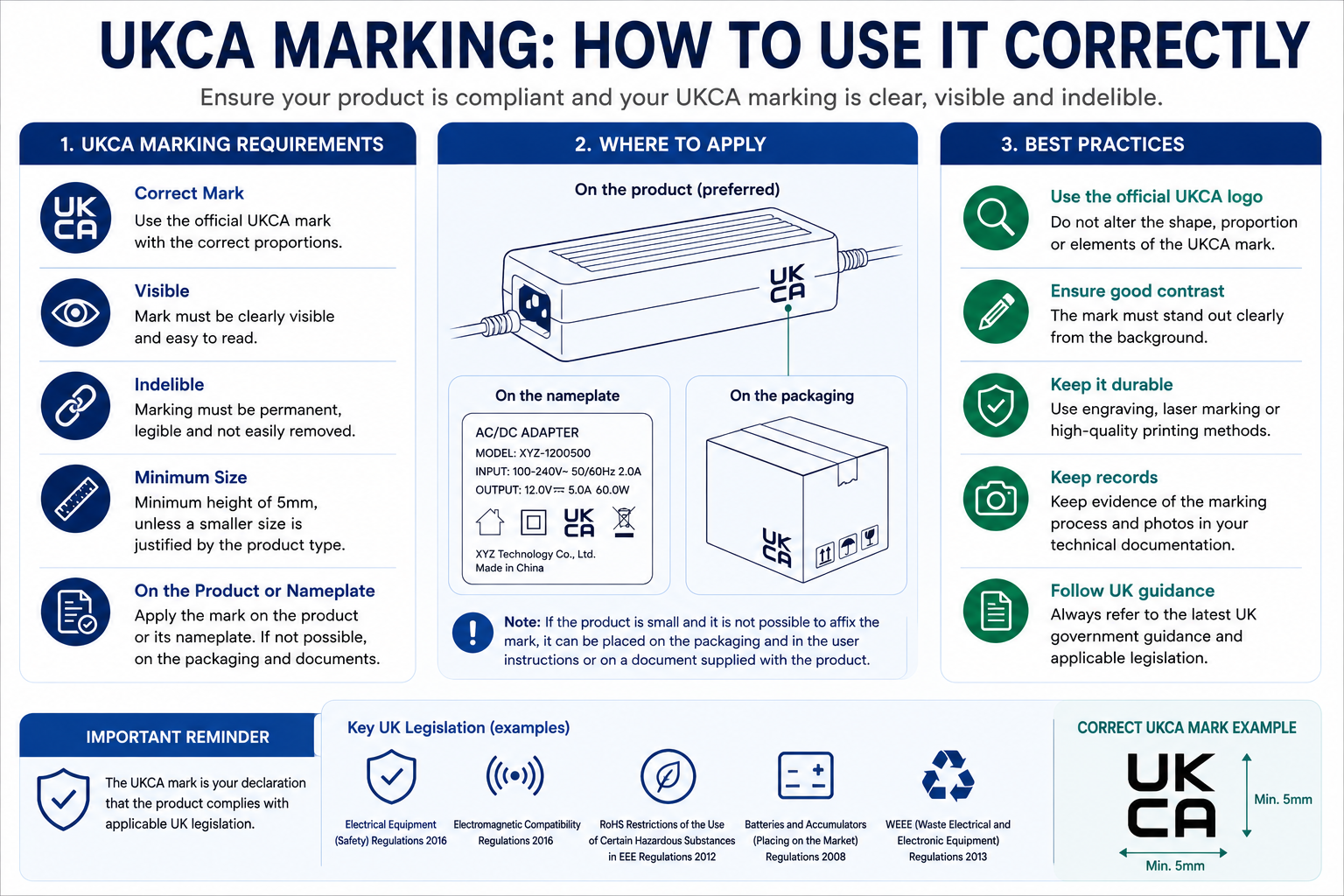
The UKCA marking must be visible, legible, and indelible under the applicable rules.
For electrical equipment, the marking should generally be placed on the product itself where practicable. Where this is not possible or appropriate because of the nature of the product, it may be placed on packaging or accompanying documentation under the applicable rules.
There is also an important transitional labeling provision.
For certain goods, including electrical equipment, the UK government currently allows the UKCA marking to be placed on a label attached to the product or on an accompanying document until 31 December 2027, rather than requiring it to be directly affixed to the product where it would otherwise be possible.
Manufacturers should therefore verify the current marking rules applicable to their specific product before finalizing artwork or packaging.
The marking itself should not be treated as a substitute for compliance documentation.
Printing the UKCA symbol on a product before conformity assessment has been completed does not make the product compliant.
For manufacturers of AC/DC power adapters, UKCA planning should begin during product development rather than after production.
A typical power adapter development project may involve:
Input voltage specification
Output voltage
Output current
Rated power
Transformer design
PCB design
Safety components
EMC components
DC cable
DC connector
Enclosure
Thermal design
Protection functions
Manufacturing controls
For example, a 19 V 90 W desktop power adapter intended for the British market may need to be evaluated differently from a small 12 V wall-mounted adapter because the product design, construction, thermal behavior, and applicable standards may differ.
A supplier should therefore be able to provide appropriate technical information rather than simply stating:
"UKCA available."
For companies developing their own branded equipment, working with an experienced Power Adapter Manufacturer can help integrate compliance considerations into the design and production process.
Battery chargers require additional engineering attention because the product interacts with a rechargeable battery system.
A charger may need to be designed around:
Battery chemistry
Cell count
Nominal voltage
Maximum charging voltage
Charging current
CC/CV profile
BMS behavior
Charge termination
Short-circuit protection
Overvoltage protection
Overcurrent protection
Thermal conditions
For example, a charger designed for a lithium-ion battery pack should not automatically be treated as interchangeable with a LiFePO4 charger.
The electrical design, charging profile, and intended battery system must be evaluated.
For companies developing specialized battery-powered products, a Battery Charger Manufacturer can help integrate charging requirements, electrical design, testing, and production considerations into one development process.
For many power adapters sold in Great Britain in 2026, the decision is not simply "UKCA or nothing."
CE marking continues to be recognized for many products in Great Britain, provided the applicable requirements are met.
A manufacturer supplying both European and British markets may therefore choose a compliance strategy that supports multiple markets.
For example, a manufacturer may develop a power adapter to meet applicable EU requirements and use CE marking where recognized in Great Britain.
Alternatively, the manufacturer may choose a UKCA route for the GB market.
The most appropriate strategy depends on:
Target markets
Product regulations
Customer requirements
Existing certifications
Testing strategy
Manufacturing configuration
Product lifecycle
Future market expansion
The UK government's current guidance specifically addresses situations where EU harmonised standards and GB designated standards are aligned or differ.
This means manufacturers should review the regulatory strategy at the beginning of a product project rather than choosing a marking at the final packaging stage.
For a broader understanding of electrical product compliance, see Power Adapter Safety Certifications Explained and What Is CE Certification?
Yes.
A product can carry both CE and UKCA markings when it meets the applicable requirements for the relevant markets.
Dual marking can be useful for manufacturers supplying products to both Great Britain and the European market.
However, dual marking does not mean that the manufacturer can simply perform one generic test and automatically claim compliance with every regulation.
The manufacturer must ensure that the applicable requirements for each marking are satisfied.
For international B2B manufacturers, a coordinated compliance strategy can sometimes reduce duplicated engineering work, but the technical documentation and declarations must still accurately support the applicable regulatory framework.
This is one reason why certification planning should be integrated into product development from the beginning.
Several mistakes can create unnecessary delays or compliance risks.
UKCA is a conformity marking framework, not one universal certification program.
The applicable regulations determine the assessment route.
This is outdated for many product categories.
The UK government has introduced continued recognition of CE for many goods, including covered electrical equipment.
Northern Ireland has different marking arrangements.
A GB compliance strategy should not automatically be applied to NI.
Compliance must be supported by product design, testing, documentation, and the applicable conformity assessment procedure.
If the product design, applicable standards, manufacturer information, or regulations change, the compliance documentation may need to be reviewed.
Changing a transformer, capacitor, fuse, switching controller, cable, connector, or other critical component can affect product compliance.
Engineering change control is therefore important.
If compliance problems are discovered after tooling and mass production have started, correction costs can be significantly higher.
Compliance requirements should be considered during the design and prototype stage.
A practical preparation checklist can help reduce delays.
Prepare:
Product name
Model number
Input rating
Output rating
Rated power
Intended application
Target market
Prepare:
Schematics
PCB information
Critical component list
Mechanical drawings
Transformer information
Protection design
Thermal analysis where applicable
Identify the required testing based on the applicable regulations and standards.
Potential testing areas may include:
Electrical safety
EMC
Energy efficiency
Environmental requirements
Material compliance
Prepare:
Technical documentation
Test reports
Declaration of Conformity
Supplier compliance documents
Product labeling information
Ensure that mass-produced units remain consistent with the assessed design.
A product that was tested successfully but subsequently changed without appropriate review may no longer be adequately represented by the original compliance documentation.
Standard products are not always suitable for every application.
B2B customers may require:
Custom output voltage
Custom output current
Specific connector
Custom DC cable length
Special enclosure
Different AC inlet
Application-specific protection
Custom charging profile
Special mechanical dimensions
In these cases, compliance should be considered together with engineering development.
A Custom Power Adapter project may involve:
Requirement analysis
Electrical design
Prototype development
Testing
Compliance evaluation
Certification support
Pilot production
Mass production
Similarly, a Custom Battery Charger may require detailed coordination between charger design, battery specifications, BMS behavior, connector requirements, and the target market's regulatory framework.
For OEM customers, the objective is not simply to add a UKCA symbol.
The objective is to develop a product that can be manufactured consistently and supported with the appropriate compliance documentation.
Purchasing teams should ask specific questions when evaluating a supplier for the Great Britain market.
Instead of asking only:
"Is the product UKCA certified?"
consider asking:
Which UK regulations apply to this product?
Is the product supplied with UKCA, CE, or both?
Which conformity assessment procedure was used?
Is third-party assessment required?
Can you provide the relevant Declaration of Conformity?
Are test reports available?
Which standards were used?
Is the tested configuration identical to the production model?
How are component changes controlled?
Can compliance documentation be updated for customized versions?
These questions provide a much clearer picture of supplier capability.
For companies purchasing power supplies on a long-term basis, compliance documentation should be treated as part of the product specification rather than as an optional marketing document.
A manufacturer that can support engineering, testing, documentation, and production provides greater value than a supplier that only provides a marking logo.
Guangdong QINX Technology Co., Ltd. develops and manufactures AC/DC power adapters, battery chargers, and customized power supply solutions for different applications and international markets.
For B2B customers, compliance requirements are considered together with electrical specifications, mechanical requirements, connector selection, application conditions, and target-market requirements.
Depending on product specifications and target markets, projects may involve standards and compliance requirements such as:
CE
UKCA
UL
cUL
FCC
DOE Level VI
PSE
SAA
CB
RoHS
The applicable requirements depend on the specific product, destination market, and regulatory framework.
Guangdong QINX can support customers through stages such as:
Requirement analysis
Product selection
Engineering development
Prototype preparation
Electrical testing
Compliance support
Production
Quality control
For customers developing products for the UK market, compliance planning can be incorporated into the project from the early specification stage.
For companies requiring broader international certification knowledge, our guide What Is UL Certification? and What Is CB Certification? provide additional background on other major certification and conformity assessment frameworks.
For a consumer buying a single power adapter, compliance may appear to be a simple labeling issue.
For a B2B product manufacturer, it is much more important.
A power adapter may be integrated into:
Medical equipment
Industrial equipment
Security systems
Audio equipment
Displays
Robotics
POS systems
Battery-powered equipment
If the power supply changes late in the product development process, the customer may need to repeat testing or review the system-level compliance impact.
This can affect:
Product launch schedules
Certification costs
Inventory
Packaging
Technical documentation
Production planning
Early coordination between the equipment manufacturer and power supply manufacturer can therefore reduce project risk.
A reliable compliance strategy starts before mass production.
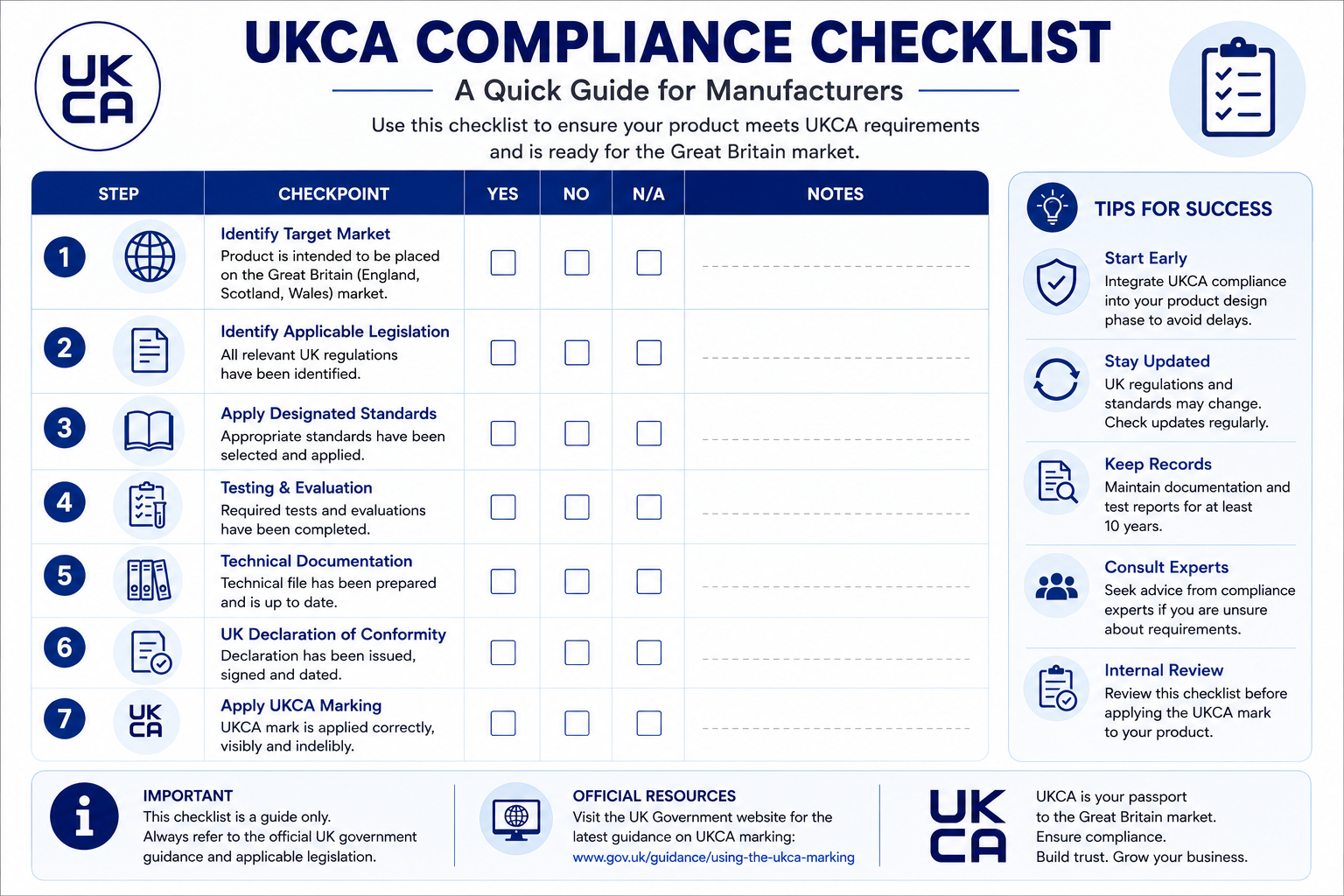
Before placing an applicable electrical product on the Great Britain market, manufacturers can use the following checklist:
Is the target market Great Britain?
Does the product also need to enter Northern Ireland or the EU?
Which marking regime applies?
Have all applicable UK regulations been identified?
Have sector-specific requirements been checked?
Have CE recognition rules been reviewed where relevant?
Are electrical specifications confirmed?
Are safety requirements addressed?
Are EMC requirements addressed?
Are materials and components controlled?
Are production changes controlled?
Are appropriate standards identified?
Are required tests completed?
Are test reports available?
Is third-party assessment required?
Is the technical documentation complete?
Is the Declaration of Conformity prepared?
Are manufacturer details correct?
Are supporting documents retained?
Is the correct conformity marking used?
Is the marking applied correctly?
Does the product labeling meet the applicable requirements?
Does mass production match the assessed design?
Are critical components controlled?
Are changes reviewed for compliance impact?
This checklist is a practical starting point, but it should not replace a product-specific regulatory assessment.
Not for every product.
UKCA is the Great Britain conformity marking for certain goods, but current UK legislation also recognizes CE marking for many product categories. The applicable requirements depend on the product and sector.
No.
UKCA relates to Great Britain product regulations, while CE relates primarily to EU product legislation. However, CE marking continues to be recognized for many products in Great Britain under current UK arrangements.
For many covered electrical products, yes, provided the product meets the applicable requirements for Great Britain and the conditions for continued CE recognition are satisfied. Manufacturers should verify the current rules for their specific product.
Power adapters can fall within UK electrical product regulations, but whether UKCA is the required or selected marking depends on the product and applicable regulatory framework.
Battery chargers may be subject to applicable UK electrical, EMC, RoHS, energy-efficiency, and other requirements depending on their design and intended use.
Not always.
Some products can use manufacturer self-declaration, while other products require third-party conformity assessment under the applicable legislation.
Depending on the product, documentation can include technical files, risk assessments, test reports, standards information, production controls, and a UK Declaration of Conformity.
Yes.
A product can carry both markings when it satisfies the applicable requirements for the relevant markets.
UKCA should not be treated as the general marking for Northern Ireland.
Northern Ireland follows different arrangements, and CE marking remains relevant for products placed on the NI market under applicable EU rules.
For electrical equipment covered by the Electrical Equipment (Safety) Regulations, manufacturers must retain technical documentation and the Declaration of Conformity for 10 years after the equipment has been placed on the Great Britain market.
Yes.
A power supply manufacturer can support product development, testing, documentation, component control, and compliance preparation, depending on its engineering and certification capabilities.
UKCA certification is best understood as part of the Great Britain product conformity framework rather than simply as a certificate or logo.
UKCA stands for UK Conformity Assessed and the UKCA marking is used for certain products placed on the Great Britain market.
However, the regulatory environment has evolved significantly since UKCA was introduced.
For many electrical products, CE marking continues to be recognized in Great Britain, meaning manufacturers may have a choice between CE and UKCA depending on the applicable regulations and product strategy.
For power adapters and battery chargers, the important questions are therefore not limited to:
"Do you have UKCA?"
A more useful compliance evaluation considers:
Which regulations apply?
Which standards are used?
What conformity assessment procedure is followed?
Is third-party assessment required?
What testing has been completed?
Is the Declaration of Conformity available?
Is the production configuration consistent with the assessed product?
Which markets does the product need to enter?
For manufacturers and B2B purchasing teams, compliance planning should begin during product development rather than at the packaging stage.
Guangdong QINX supports customers with AC/DC power adapters, battery chargers, and customized power supply solutions, helping integrate electrical specifications, engineering development, testing, compliance considerations, and mass production into a coordinated product-development process.
Whether you are sourcing a standard power adapter, developing a customized battery charger, or planning an OEM power supply project for the Great Britain market, selecting a technically capable manufacturing partner can help reduce compliance and production risks.
The most important principle is simple:
Do not treat UKCA as a logo. Treat it as part of the product compliance process.


